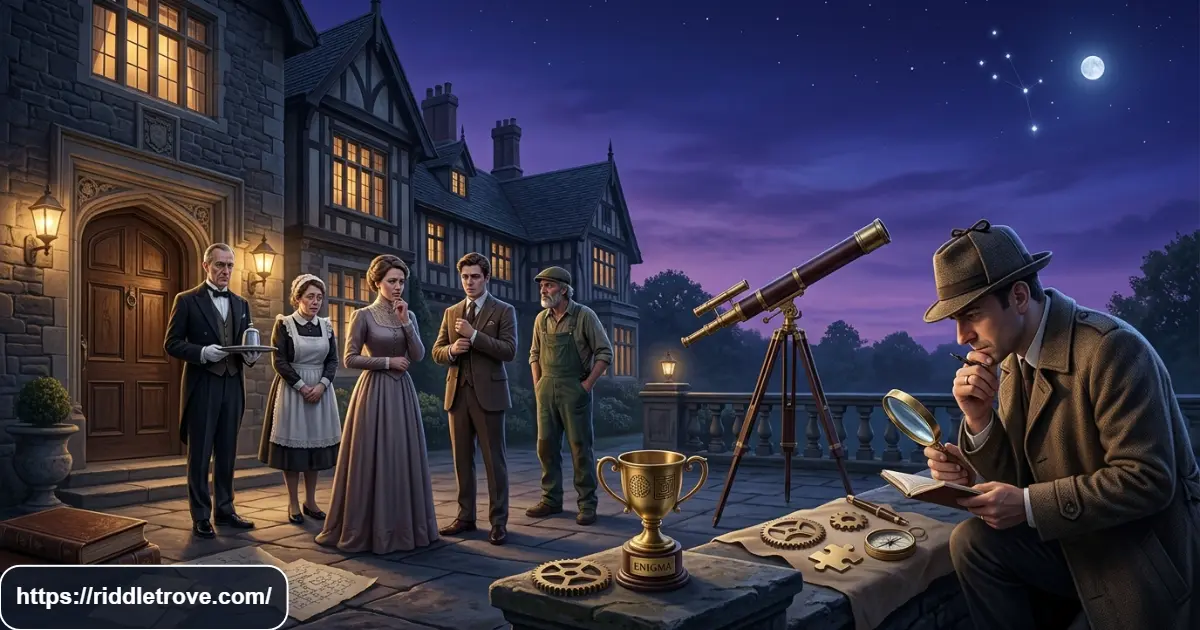
The who killed Mrs. Smith riddle is a short mystery puzzle built around alibis, timing, and one suspicious detail. It looks simple because each suspect appears to have a normal reason for being elsewhere, but one statement does not fit the situation.
The trick is to read every clue carefully instead of choosing the person who seems most suspicious. Below, you can test your deduction skills with short mystery riddles, hints, and answers. Start with the classic Mrs. Smith puzzle, then work through the other challenges without checking the answers too quickly.
Who Killed Mrs. Smith? 🕵️
Riddle 1: Mrs. Smith was killed Sunday evening. The chef cooked dinner, the butler got wine, the maid set the table, and the gardener pruned trees. Mr. Smith said he was stargazing. Who is suspicious?
Answer: Mr. Smith.
Explanation: The intended clue is that Mr. Smith claimed to be stargazing while it was still evening.
Riddle 2: Four workers had chores. One man said he was watching the stars. Why might his alibi fail?
Answer: The timing.
Riddle 3: A woman was killed Sunday evening. Everyone had a task except her husband, who claimed to be outside watching stars. Who should you question first?
Answer: Her husband.
Riddle 4: The chef cooked, the butler served, the maid prepared, and the gardener worked. One person watched the sky. Who gave the unusual alibi?
Answer: Mr. Smith.
Riddle 5: Mrs. Smith died on Sunday evening. Her husband said he was stargazing. What clue should you examine?
Answer: The word “evening.”
Riddle 6: Everyone had a household job except one suspect. His excuse involved stars. Who was he?
Answer: Mr. Smith.
Riddle 7: A murder happened at home. Four people described ordinary chores. The husband described the sky. Which statement stands out?
Answer: The husband’s.
Riddle 8: Mrs. Smith was killed during the evening. Her husband claimed he was looking at stars. What makes this clue suspicious?
Answer: His claimed activity depends on the timing.
Riddle 9: The cook, butler, maid, and gardener all had tasks. The husband had none. Which alibi deserves attention?
Answer: Mr. Smith’s alibi.
Riddle 10: Who is the intended answer in the classic Mrs. Smith mystery?
Answer: Mr. Smith, her husband.

Mrs. Smith Riddle Hints 🔎
Riddle 11: The killer did not need to hide every clue. Which clue can expose an alibi?
Answer: The timing.
Riddle 12: Four suspects mention chores. One mentions the night sky. Which clue is different?
Answer: The stargazing clue.
Riddle 13: When solving the Mrs. Smith puzzle, should you focus on motives or statements?
Answer: Statements.
Riddle 14: One suspect describes an activity that depends on darkness. What should you check?
Answer: The time.
Riddle 15: The answer is not hidden in the chef’s actions. Which suspect gives the unusual excuse?
Answer: Mr. Smith.
Riddle 16: What single word makes the husband’s alibi worth examining?
Answer: “Evening.”
Riddle 17: Everyone else was busy inside. Who claimed to be looking upward?
Answer: Mr. Smith.
Riddle 18: A good mystery clue can be hidden in a person’s alibi. Whose alibi matters here?
Answer: The husband’s.
Riddle 19: If someone says they were watching stars, what condition might matter?
Answer: Darkness.
Riddle 20: Which clue should you inspect before choosing a suspect?
Answer: The suspect’s alibi.
Tricky Who-Did-It Riddles 🧩
Riddle 21: A man says he was asleep, but his alarm was never set. What should you question?
Answer: His alibi.
Riddle 22: Three people entered a room. Only one left footprints. Who should be investigated?
Answer: The person who left the footprints.
Riddle 23: A thief says he was outside, but his shoes are completely dry after heavy rain. What seems wrong?
Answer: His story.
Riddle 24: A suspect says he never touched the door, but his fingerprints are on the handle. What does that suggest?
Answer: His statement may be false.
Riddle 25: A guard says he saw the event through a closed curtain. What should you question?
Answer: How he could see it.
Riddle 26: A suspect claims he was alone, but a second cup is beside him. What clue matters?
Answer: The second cup.
Riddle 27: Someone says the lights were off, yet describes the color of a shirt. What is suspicious?
Answer: The description.
Riddle 28: A man claims he arrived after the accident, but his coat is already wet. What could that mean?
Answer: He may have been outside earlier.
Riddle 29: A witness says the room was silent, but also heard a clock strike. What does that reveal?
Answer: The room was not completely silent.
Riddle 30: A suspect gives a perfect story but gets one time wrong. What should you inspect?
Answer: The timeline.

Short Mystery Riddles With Answers 🕯️
Riddle 31: A clock stops at the exact moment of a crime. What could it provide?
Answer: A time clue.
Riddle 32: A locked room has wet footprints leading inside but none leading out. What is unusual?
Answer: The missing exit trail.
Riddle 33: A suspect says the window was open, but the curtains never moved. What might be wrong?
Answer: The window story.
Riddle 34: A witness says it was dark, but identifies someone by their face. What should you question?
Answer: Visibility.
Riddle 35: A man says he was cooking, but the stove is cold. What does that suggest?
Answer: His alibi may be false.
Riddle 36: A person claims to have heard a phone ring, but the phone was disconnected. What is suspicious?
Answer: The claim.
Riddle 37: A suspect says he was reading, but the book is unopened. What could that mean?
Answer: His story may not fit the evidence.
Riddle 38: A person claims to have seen rain through a window, but the glass is covered. What should you ask?
Answer: How they saw it.
Riddle 39: A witness remembers everything except the most important minute. What should you examine?
Answer: Their timeline.
Riddle 40: A suspect knows a detail never publicly shared. What could that reveal?
Answer: They may know more than they should.
Final Mystery Riddle Challenge 🎯
Riddle 41: A man says he arrived at 8:00, but the clock was broken at 7:30. What must you check?
Answer: Another reliable time source.
Riddle 42: A woman says she heard footsteps upstairs, but the staircase was blocked. What is suspicious?
Answer: How she heard them.
Riddle 43: A suspect says he was outdoors, but his umbrella is completely dry during a storm. What should you question?
Answer: His alibi.
Riddle 44: A witness says the room was dark, yet noticed a tiny red mark. What should you examine?
Answer: Whether the mark was visible.
Riddle 45: A suspect claims he never entered the kitchen, but his wet footprints stop there. What does the clue suggest?
Answer: He was likely in the kitchen.
Riddle 46: A man says he heard the front door close, but the door has no working latch. What is questionable?
Answer: His story.
Riddle 47: A suspect says he was outside during snowfall, but there is no snow on his shoes. What should you consider?
Answer: His claimed location.
Riddle 48: A witness gives three times for the same event. What should you check first?
Answer: The timeline.
Riddle 49: A suspect remembers a detail that only the killer should know. What is the key clue?
Answer: His knowledge.
Riddle 50: Five people give alibis. Four match the timeline, but one does not. Who deserves closer attention?
Answer: The person with the inconsistent alibi.
Conclusion
The who killed Mrs. Smith riddle works because the answer depends on noticing a small detail instead of simply guessing the most suspicious person. The intended answer is Mr. Smith, whose stargazing alibi creates the puzzle’s central timing clue. When solving similar mystery riddles, compare every statement with the known timeline and look for details that cannot logically fit. A strong alibi should agree with the evidence, the setting, and the time. Sometimes one unusual sentence is enough to reveal the entire mystery.
Frequently Asked Questions
Who killed Mrs. Smith in the riddle?
The intended answer is Mr. Smith, Mrs. Smith’s husband.
What is the main clue in the Mrs. Smith riddle?
The main clue is Mr. Smith’s claim that he was stargazing during the evening.
Why is Mr. Smith suspicious?
His alibi involves an activity that depends on the available light and timing, making his statement the key clue.
What should you look for when solving the riddle?
Look closely at each suspect’s statement, especially the timing, location, and whether the claimed activity was possible.
Is the Mrs. Smith riddle difficult?
It is generally a tricky lateral-thinking riddle because the important clue is easy to overlook.
Why do the other suspects seem innocent?
The chef, butler, maid, and gardener each have ordinary tasks that provide the intended alibi structure of the puzzle.
Is the “evening” clue completely unambiguous?
Not necessarily. The intended solution depends on how the word “evening” is interpreted, which is why some readers debate the puzzle.
What makes a good who-did-it riddle?
A good mystery riddle gives enough information to reach one strongest answer without requiring an unexplained assumption.