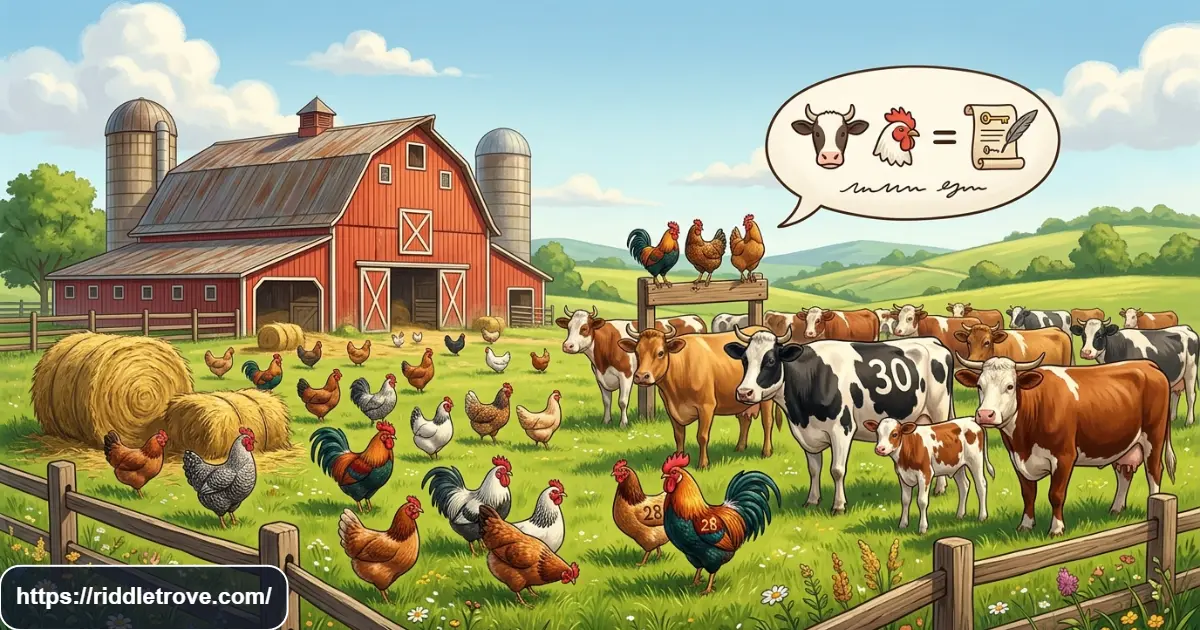
The 30 cows and 28 chickens riddle looks like a simple counting puzzle, but the numbers are hiding a clever language trick. If you try to solve it as ordinary subtraction, the wording can seem strange and the answer may not make sense at first.
The key is to stop looking at 28 only as a number and listen to how it sounds when spoken aloud. Once you notice the sound-alike phrase, the puzzle becomes much easier to understand. Below, you can try the original riddle, use a hint, check the answer, and then explore more short wordplay riddles.
What Is the 30 Cows and 28 Chickens Riddle? 🐄
Here is the classic puzzle:
Riddle 1: A farmer has 30 cows and 28 chickens. How many didn’t?
Answer: 10
Explanation: The trick is to hear 28 as “twenty ate.” If 20 cows “ate” the chickens, then 10 cows did not. So, 30 − 20 = 10.
The clever part is not really the math. The subtraction is easy once you understand the hidden phrase. The difficult part is recognizing that the number 28 is being used for its sound rather than only its numerical value.
When you read the sentence silently, your brain naturally sees “twenty-eight.” When you say it aloud, however, the wording can be interpreted as “twenty ate.” That second interpretation creates the answer.
This is why the riddle is a good example of phonetic wordplay. It uses a familiar number in an unexpected way and encourages you to think about how language sounds instead of taking every word literally.
Hint for the 30 Cows and 28 Chickens Riddle 💡
If you are trying to solve the riddle without looking at the answer, start by asking yourself a simple question:
Could “28” sound like something else?
Don’t focus too much on the number itself. Say the phrase slowly:
Twenty-eight.
Now listen for another possible meaning.
The important part is the sound “eight.” It is pronounced the same as “ate.” That small difference in spelling changes the meaning of the sentence.
So the riddle isn’t asking you to perform complicated multiplication, division, or counting. Instead, it uses a sound-alike phrase to hide the important clue.
A Second Hint
Think about something that can happen during a meal.
The word “ate” describes something someone has already done with food. When you connect that word to the number eight, the trick starts to appear.
Final Hint
Read 28 as:
twenty ate
Now ask:
If 20 ate, how many did not?
At that point, the answer should be easy to find.
30 Cows and 28 Chickens Riddle Answer 🧩
The intended answer is:
10
Here is the wordplay in its simplest form:
28 → twenty ate
The riddle says there are 30 cows and 28 chickens. The trick treats “28” as “twenty ate,” meaning 20 cows ate the chickens.
So:
30 − 20 = 10
Therefore, 10 cows didn’t eat the chickens.
The riddle works because “eight” and “ate” are homophones. They sound the same but have different meanings and spellings.
This is also why the puzzle can feel confusing when you first see it. Your eyes read 28 as a number. The intended solution asks you to hear the number as a phrase.
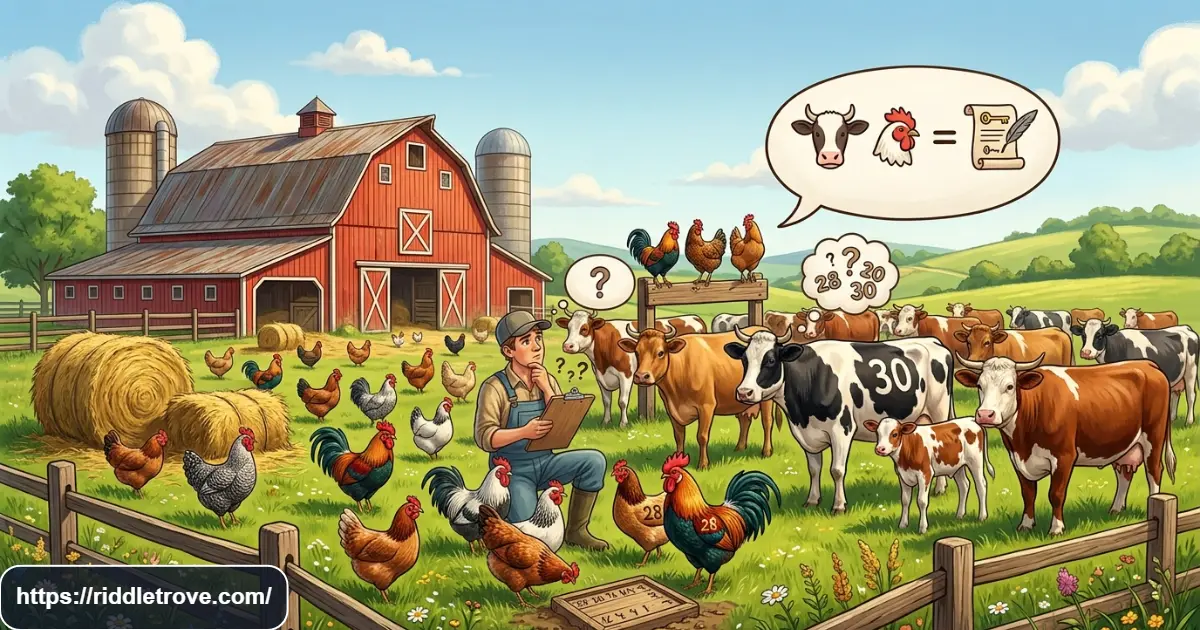
Why Is the Answer 10?
The answer is sometimes confusing because readers naturally try to interpret the entire sentence literally.
If you think of “28 chickens” simply as twenty-eight chickens, the question “How many didn’t?” appears incomplete. Didn’t what? Didn’t exist? Didn’t eat? Didn’t belong to the farm?
The missing action is revealed through the sound of 28.
The phrase can be separated like this:
28 = twenty-eight
The riddle wants you to hear it as:
twenty ate
That gives the sentence an implied meaning:
Twenty cows ate.
There were 30 cows altogether, so the number that did not eat is:
30 − 20 = 10
This is a classic example of a riddle where the wording matters more than the arithmetic. You don’t need advanced math to solve it. You need to notice the unusual way the number is being used.
Another reason the riddle works well is that the answer seems hidden in plain sight. The number 28 is already sitting in the sentence, but you have to reinterpret its sound to discover the clue.
Why Does This Riddle Work Better When Spoken?
The 30 cows and 28 chickens riddle is especially interesting because the trick depends on pronunciation.
On paper, you see:
28
Your brain immediately recognizes it as a number.
But when someone says:
“Twenty-eight”
you can hear a phrase that resembles:
“Twenty ate.”
That makes this riddle more effective when read aloud.
It also explains why some people may not understand the joke immediately. Written riddles don’t always preserve the sound and rhythm that make a wordplay trick obvious.
For a group game, family activity, or party, this riddle can work particularly well when one person reads it aloud and gives everyone a few seconds to think before revealing the answer.
The best approach is to let people attempt the puzzle first. If they get stuck, give the hint about listening to the number. That preserves the “aha” moment instead of giving away the solution immediately.
Short Wordplay Riddles With Answers 🔤
The original puzzle belongs to a larger family of riddles based on sounds, spelling, and double meanings. These short riddles use similar thinking skills without simply repeating the “twenty ate” trick.
Riddle 11
Riddle 11: What word sounds like an ocean?
Answer: See
Explanation: “See” sounds like “sea.”
Riddle 12
Riddle 12: What word sounds like something you can read?
Answer: Red
Explanation: “Read” and “red” can sound alike when “read” is pronounced in the past tense.
Riddle 13
Riddle 13: What word sounds like a fruit and a number?
Answer: Pear
Explanation: “Pear” sounds like “pair,” which means two.
Riddle 14
Riddle 14: What word sounds like a direction?
Answer: Write
Explanation: “Write” sounds like “right,” a direction.
Riddle 15
Riddle 15: What word sounds like an animal with long ears?
Answer: Hair
Explanation: “Hair” sounds like “hare.”
Riddle 16
Riddle 16: What word sounds like a place for ships?
Answer: Peer
Explanation: “Peer” sounds like “pier,” where ships can dock.
Riddle 17
Riddle 17: What word sounds like a meeting?
Answer: Meat
Explanation: “Meat” sounds like “meet.”
Riddle 18
Riddle 18: What word sounds like a writing material?
Answer: Stationary
Explanation: “Stationary” sounds like “stationery,” which means writing materials.
Riddle 19
Riddle 19: What word sounds like something you send?
Answer: Cent
Explanation: “Cent” sounds like “sent.”
Riddle 20
Riddle 20: What word sounds like something you might wear?
Answer: Sole
Explanation: “Sole” sounds like “sole” in shoe-related wordplay and can also mean the bottom of a foot.

Tricky Language Riddles 🧠
Not every wordplay riddle depends on a perfect homophone. Some use double meanings, spelling changes, or a word that can be understood in two different ways.
These puzzles are useful because they encourage you to question your first interpretation. Instead of immediately choosing the most obvious meaning, look for another way the clue could work.
Riddle 21
Riddle 21: What has a bark but no bite?
Answer: A tree
Explanation: A tree has bark, but it cannot bite.
Riddle 22
Riddle 22: What has a face but no eyes?
Answer: A clock
Explanation: A clock has a face but no eyes.
Riddle 23
Riddle 23: What has hands but cannot clap?
Answer: A clock
Explanation: A clock has hands, but they cannot clap.
Riddle 24
Riddle 24: What has keys but opens no locks?
Answer: A piano
Explanation: A piano has keys, but they are not used to open locks.
Riddle 25
Riddle 25: What has a neck but no head?
Answer: A bottle
Explanation: A bottle has a neck but no head.
Riddle 26
Riddle 26: What has teeth but cannot chew?
Answer: A zipper
Explanation: A zipper has teeth that interlock but cannot chew.
Riddle 27
Riddle 27: What can run but never walks?
Answer: Water
Explanation: Water can run through a stream or pipe but cannot walk.
Riddle 28
Riddle 28: What has an eye but cannot see?
Answer: A needle
Explanation: A needle has an eye for threading, but it cannot see.
Riddle 29
Riddle 29: What has a thumb and four fingers but isn’t alive?
Answer: A glove
Explanation: A glove has spaces shaped for a thumb and four fingers.
Riddle 30
Riddle 30: What can travel around the world while staying in one corner?
Answer: A stamp
Explanation: A stamp can travel on a letter while remaining in its corner.
How to Solve Wordplay Riddles More Easily
Wordplay riddles often become easier when you stop assuming that every word has only one meaning.
The 30 cows and 28 chickens riddle is a perfect example. The number looks completely ordinary, but its pronunciation provides another possible interpretation.
When a riddle seems incomplete, ask yourself whether a word or number could have a second meaning.
Listen for Sound-Alikes
Words such as eight and ate, sea and see, or pair and pear sound alike while having different meanings.
If a riddle feels strange, say the important phrase aloud. Sometimes the answer becomes obvious once you hear it.
Look for Double Meanings
Words can describe different things depending on context. For example, a clock can have hands and a face, even though it isn’t a person.
Riddles often use everyday words in unexpected ways.
Question the Obvious Interpretation
Your first answer isn’t always wrong, but it may not be what the riddle is asking.
For the cows and chickens puzzle, treating 28 as only a number makes the sentence confusing. Treating it as “twenty ate” reveals the intended meaning.
Check Every Clue
A good riddle should have an answer that fits the important clues. If your proposed answer only explains one part of the puzzle while ignoring the rest, keep looking.
Say the Riddle Aloud
This is especially important for phonetic riddles. A phrase that looks ordinary on the screen may sound completely different when spoken.
Conclusion
The 30 cows and 28 chickens riddle is a clever wordplay puzzle disguised as a simple counting question. Its intended answer is 10, because 28 can be heard as “twenty ate.” Once that sound-based trick is recognized, the final calculation is easy: 30 cows minus 20 cows that ate leaves 10 that did not. The puzzle also shows why reading a riddle aloud can sometimes reveal clues that are easy to miss on the page. If you enjoy this type of challenge, the short wordplay and language riddles above provide plenty of similar twists to solve and share.
Frequently Asked Questions
What is the 30 cows and 28 chickens riddle answer?
The intended answer is 10. The number 28 is interpreted as “twenty ate,” meaning 20 cows ate, leaving 10 that did not.
Why does 28 mean “twenty ate”?
The phrase “twenty-eight” can be heard as “twenty ate.” The words “eight” and “ate” have the same pronunciation.
How do you solve the 30 cows and 28 chickens riddle?
First, reinterpret 28 as “twenty ate.” Then subtract 20 from the 30 cows: 30 − 20 = 10.
Is this a math riddle?
Only partly. The final step uses simple subtraction, but the main challenge is phonetic wordplay, not mathematics.
Why do some people find the riddle confusing?
The written version naturally makes readers see 28 as a number. The intended solution depends on hearing it as a phrase, so the trick may be easier to understand when the riddle is spoken aloud.
What type of riddle is this?
It is mainly a wordplay, phonetic, and lateral-thinking riddle. The puzzle uses the sound of a number to create another meaning.
Can the riddle be used as a party or family puzzle?
Yes. It works well as a quick spoken puzzle because people can hear the wording before the answer is revealed. Give the hint only if players need help.
What is the main trick in the riddle?
The main trick is the sound-alike connection:
28 → twenty-eight → twenty ate
That interpretation changes the puzzle from a confusing question into a simple subtraction problem.