
The nine dots riddle looks almost too simple. You see nine dots arranged in a neat 3×3 square, and your job is to connect every dot using only four straight lines without lifting your pencil. The catch is that your brain may quietly add a rule that the puzzle never gives you.
Try it before looking at the answer. If you get stuck, use the hints one at a time. After the solution, you’ll also find harder nine-dot variations and short lateral-thinking challenges that test the same kind of creative reasoning.
The Classic Nine Dots Riddle 🔵
Try each challenge before revealing the answer. For the classic puzzle, imagine the dots arranged like this:
●   ●   ●
●   ●   ●
●   ●   ●
Riddle 1: Connect all nine dots using exactly four straight lines without lifting your pencil.
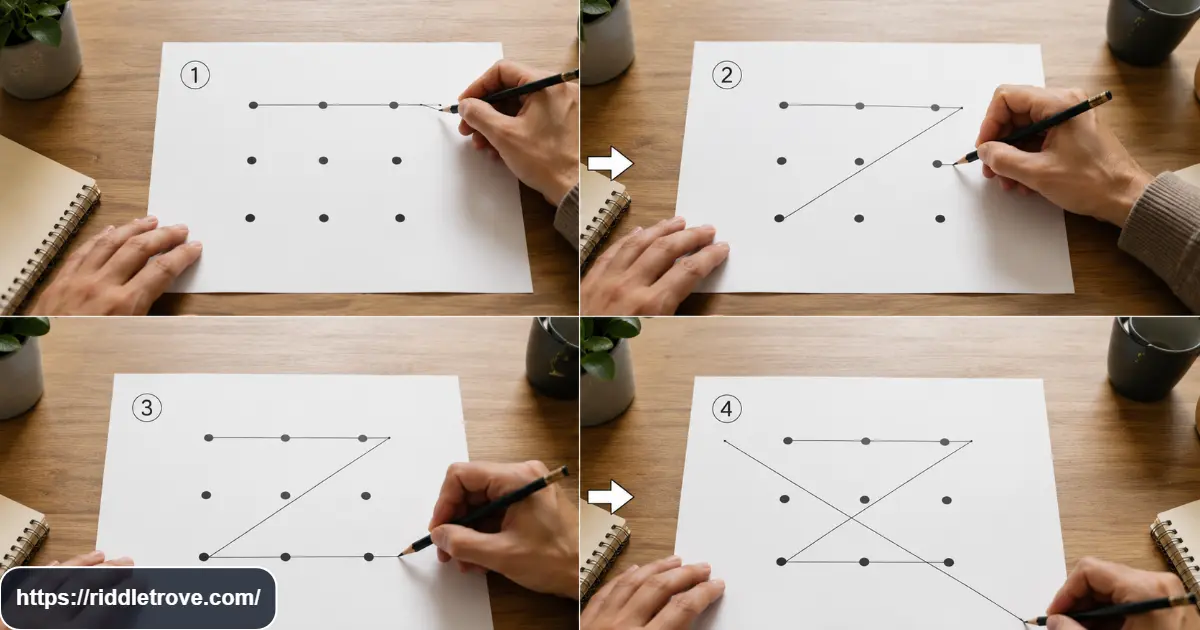
Answer: Draw four connected lines that extend beyond the imaginary square formed by the outside dots.
Explanation: The puzzle never says your lines must remain inside the square.
Riddle 2: Can you connect all nine dots with four straight lines if your first line begins at the top-left dot?
Answer: Yes. Start at the top-left and continue beyond the top-right dot before changing direction.
Explanation: Extending outside the dot pattern creates the space needed for the remaining lines.
Riddle 3: What hidden rule makes the nine dots puzzle seem harder than it really is?
Answer: An imaginary boundary.
Explanation: Most solvers assume the lines must stay inside the 3×3 arrangement, even though that restriction isn’t stated.
Riddle 4: You have nine dots and four straight lines. You may not lift your pencil. What should you avoid assuming?
Answer: Avoid assuming there is a box around the dots.
Explanation: The visible arrangement looks like a square, but the square itself is not a rule.
Riddle 5: What must happen to at least some of your lines to solve the classic puzzle?
Answer: They must extend beyond the outer dots.
Explanation: The extra space outside the pattern lets one line reach multiple dots before turning.
Riddle 6: If every line must stay inside the invisible square around the dots, can the classic four-line solution work?
Answer: No.
Explanation: The standard solution depends on extending lines outside that imagined boundary.
Riddle 7: What is the simplest lesson hidden inside the nine dots riddle?
Answer: Don’t add rules that were never stated.
Explanation: The puzzle rewards careful reading as much as drawing skill.
Riddle 8: Why can someone understand the solution instantly after seeing it but fail to find it beforehand?
Answer: The solution breaks an assumption that feels natural.
Explanation: Once the imaginary boundary disappears, the solution becomes much easier to see.
Riddle 9: Does the classic puzzle require complicated mathematics?
Answer: No.
Explanation: It mainly requires spatial reasoning and a willingness to question an unstated constraint.
Riddle 10: What is the famous phrase most closely associated with the insight behind the nine dots puzzle?
Answer: “Think outside the box.”
Explanation: The phrase describes the act of moving beyond the imaginary square surrounding the dots.
Nine Dots Riddle Hints 🧠
If you’re stuck, don’t jump straight to the solution. These short hints gradually reveal the key idea.
Riddle 11: The dots don’t create a real wall. What does that suggest?
Answer: You can use space outside the dots.
Explanation: The outer dots only mark points; they do not create a physical boundary.
Riddle 12: Look at the three dots across the top. Where could a line go after passing the last dot?
Answer: It can continue beyond the last dot.
Explanation: A line does not have to stop when it reaches a dot.
Riddle 13: What if a line starts on one side of the pattern and travels farther than you expected?
Answer: It may reach another row when you change direction.
Explanation: Extending a line gives you more room to cross several rows.
Riddle 14: Which instruction is actually present: “stay inside the square” or “use four straight lines”?
Answer: “Use four straight lines.”
Explanation: The boundary is something solvers often invent themselves.
Riddle 15: If a rule isn’t written in the instructions, must you follow it?
Answer: No.
Explanation: A good puzzle solver should separate stated rules from assumptions.
Riddle 16: What should you inspect when every obvious four-line attempt fails?
Answer: Your assumptions.
Explanation: Repeating the same strategy rarely helps when the problem itself is being interpreted incorrectly.
Riddle 17: Does a line have to end exactly on the last dot it touches?
Answer: No.
Explanation: A straight line can continue past a dot.
Riddle 18: What area of the page is often ignored while solving the nine dots puzzle?
Answer: The space outside the dot pattern.
Explanation: That unused space is essential to the classic solution.
Riddle 19: If the dots look like a square, does that prove there is a square boundary?
Answer: No.
Explanation: Appearance is not the same as an instruction.
Riddle 20: What question should you ask when a puzzle seems impossible under your current strategy?
Answer: “What am I assuming that the puzzle never said?”
Explanation: Challenging hidden assumptions is one of the main skills behind lateral thinking.
Nine Dots Solution Explained Step by Step ✏️
The classic solution is easier to understand when you focus on the path rather than memorizing a picture.
Riddle 21: What is the first thing you should do before attempting the four-line solution?
Answer: Identify the nine dots as three rows of three.
Explanation: Seeing the geometry clearly makes it easier to plan the path.
Riddle 22: Should the first line necessarily stop at the third dot in the top row?
Answer: No.
Explanation: Continue past the final dot to create room for the next direction.
Riddle 23: What is the key geometric trick in the standard solution?
Answer: Lines extend beyond the outer dots.
Explanation: That extra length allows the path to cover all three rows efficiently.
Riddle 24: What happens if you treat the outside dots as the edges of an imaginary box?
Answer: You unnecessarily restrict the solution.
Explanation: The imaginary box removes useful drawing space.
Riddle 25: Why are four lines enough?
Answer: Because a single line can pass through multiple dots before changing direction.
Explanation: The solution uses long connected lines rather than short segments between neighboring dots.
Riddle 26: Does the pencil need to leave the paper between lines?
Answer: No.
Explanation: The four lines must form one continuous drawing.
Riddle 27: What kind of movement should you plan before drawing?
Answer: A continuous path that crosses as many required dots as possible.
Explanation: Planning the path prevents wasted turns.
Riddle 28: What makes the solution different from most failed attempts?
Answer: It uses the space beyond the apparent square.
Explanation: Failed attempts usually stay trapped inside the visual boundary.
Riddle 29: Is the trick mainly mathematical or perceptual?
Answer: Perceptual.
Explanation: The important breakthrough comes from changing how you interpret the diagram.
Riddle 30: Once you understand the solution, what should you remember for other puzzles?
Answer: Question unstated constraints.
Explanation: Many lateral-thinking problems become easier when you inspect what the instructions actually require.
Why the Nine Dots Puzzle Is So Tricky 🔍
The nine dots riddle is a classic example of how perception can influence problem solving. The dots visually form a square, so solvers often behave as if the square were part of the rules.
Riddle 31: Which is harder to break: a written rule or an imagined rule?
Answer: An imagined rule.
Explanation: You may not notice that you’re following it because nobody explicitly told you to.
Riddle 32: If a puzzle shows a square-shaped arrangement, what should you check before treating the square as a boundary?
Answer: Check the instructions.
Explanation: Visual organization does not automatically create a restriction.
Riddle 33: What is a common reason people repeat failed attempts at this puzzle?
Answer: They keep the same hidden assumption.
Explanation: Changing the drawing without changing the interpretation often produces the same failure.
Riddle 34: Does “outside the box” necessarily mean there is a physical box?
Answer: No.
Explanation: Here, the “box” is the mental boundary created by the arrangement of dots.
Riddle 35: What kind of thinking does the nine dots puzzle encourage?
Answer: Lateral thinking.
Explanation: You solve it by changing your perspective instead of simply repeating conventional moves.
Riddle 36: If you are allowed four lines, should you assume each line must stay close to the dots?
Answer: No.
Explanation: The rules specify straight lines, not short lines.
Riddle 37: What should you do when a visual pattern seems to contain an obvious boundary?
Answer: Ask whether the boundary is real or imagined.
Explanation: This question can reveal hidden assumptions.
Riddle 38: Why is the puzzle a useful problem-solving exercise?
Answer: It separates actual constraints from assumed constraints.
Explanation: That distinction is useful far beyond puzzles.
Riddle 39: What is more important than drawing faster?
Answer: Interpreting the rules accurately.
Explanation: Speed cannot compensate for an incorrect understanding of the problem.
Riddle 40: What is the “aha” moment in the nine dots riddle?
Answer: Realizing that the lines can leave the apparent square.
Explanation: That single insight changes the entire problem.
Harder Nine Dots Variations 🔥
Once you know the classic solution, the original challenge loses some of its difficulty. These variations restore the challenge by changing the constraints.
Riddle 41: Connect the same nine dots with four straight lines, but make every turn occur outside the area enclosed by the outer dots.
Answer: Use the extended-line strategy deliberately.
Explanation: The variation forces you to recognize that the outer area is useful rather than forbidden.
Riddle 42: Can you connect all nine dots with four connected lines if your second line must pass through the center dot?
Answer: Yes.
Explanation: Plan the entire path first and use the center as a required crossing point.
Riddle 43: Can you solve the nine-dot puzzle while making your first line pass through three dots?
Answer: Yes.
Explanation: A carefully positioned straight line can cross three aligned dots.
Riddle 44: Can you connect all nine dots with four lines if no line is allowed to stop at the center dot?
Answer: Yes.
Explanation: The center can be crossed without being the endpoint of a line.
Riddle 45: What changes if the puzzle allows five lines instead of four?
Answer: The constraint becomes easier.
Explanation: An additional line gives you more opportunities to cover the dots.
Riddle 46: What changes if the puzzle allows only three straight lines?
Answer: The challenge becomes substantially harder.
Explanation: You must cover more dots with fewer directional changes.
Riddle 47: If a variation allows lines to cross, should you treat a crossing as a forbidden move?
Answer: No, unless the rules say so.
Explanation: Crossing lines is another example of a detail that should not be invented.
Riddle 48: If a variation says “continuous lines,” can you lift your pencil between segments?
Answer: No.
Explanation: Continuous drawing means the path must remain connected.
Riddle 49: If the puzzle adds a boundary around the nine dots, what happens to the classic solution?
Answer: The standard outside-the-box solution may no longer be allowed.
Explanation: This time the boundary is an actual stated constraint.
Riddle 50: What is the best way to make a nine-dot variation genuinely harder?
Answer: Change a meaningful constraint rather than simply adding confusing wording.
Explanation: Good difficulty comes from reasoning, not ambiguity.
Nine Dots Logic Challenges for Kids and Students 🎓
The classic puzzle can work well as a short classroom or family activity because it requires very little equipment. Educational resources have used nine-dot activities with students at different levels.
Riddle 51: You have nine dots in three rows. How many dots are in the middle row?
Answer: Three.
Explanation: Each row contains three dots.
Riddle 52: If the nine dots form three equal rows, how many dots are in each column?
Answer: Three.
Explanation: The arrangement is a 3×3 grid.
Riddle 53: What shape do the outside dots appear to outline?
Answer: A square.
Explanation: The four corner dots and the outer arrangement create that visual impression.
Riddle 54: Does the apparent square have to be a rule?
Answer: No.
Explanation: It is only an arrangement unless the instructions make it a boundary.
Riddle 55: What skill does the puzzle practice when a student questions the imaginary boundary?
Answer: Flexible problem solving.
Explanation: The student is changing strategy instead of repeating a failed approach.
Riddle 56: If two students use different valid paths, can both solutions be correct?
Answer: Yes.
Explanation: A puzzle can have more than one valid path when the rules allow it.
Riddle 57: What should a student do before asking for the answer?
Answer: Try a hint.
Explanation: A small clue can preserve the problem-solving experience.
Riddle 58: Why is drawing the puzzle useful for visual learners?
Answer: The relationships between the dots can be seen directly.
Explanation: The challenge depends heavily on spatial arrangement.
Riddle 59: What is a good classroom question after solving the puzzle?
Answer: “Which rule did you assume that wasn’t actually written?”
Explanation: This shifts the activity from finding an answer to understanding the reasoning.
Riddle 60: What is more valuable than memorizing the four-line path?
Answer: Learning how to question assumptions.
Explanation: The transferable skill is useful in mathematics, science, and everyday problem solving.

Nine Dots Logic Challenges for Adults 🧩
Adults who already know the classic solution need a different kind of challenge. The following problems keep the emphasis on assumptions, constraints, and reasoning.
Riddle 61: A puzzle says, “Draw four straight lines through nine dots.” It never says the lines must be connected. What can you infer?
Answer: Connected lines are not required unless stated.
Explanation: The exact wording determines the constraint.
Riddle 62: A puzzle says, “Connect every dot with four lines.” Does that automatically mean the lines must remain inside the visible pattern?
Answer: No.
Explanation: The visible pattern is not itself a boundary.
Riddle 63: You are told to use four lines, but you draw only three. What kind of problem is that?
Answer: A rule violation.
Explanation: The number of lines is an explicit constraint.
Riddle 64: You use four lines but lift your pencil three times. Have you solved the classic puzzle?
Answer: No.
Explanation: The classic version requires one continuous drawing.
Riddle 65: You connect every dot but use curved lines. Have you followed the standard rules?
Answer: No.
Explanation: The puzzle requires straight lines.
Riddle 66: You use four straight connected lines and touch every dot, but your lines extend outside the visible pattern. Is that allowed?
Answer: Yes.
Explanation: Nothing in the standard instructions forbids extending the lines.
Riddle 67: Which is a stronger solving strategy: “What drawing looks natural?” or “What does the rule actually require?”
Answer: “What does the rule actually require?”
Explanation: Natural-looking assumptions can be exactly what makes a puzzle difficult.
Riddle 68: If removing one assumption makes an impossible puzzle possible, what should you investigate?
Answer: Whether that assumption was actually part of the rules.
Explanation: This is a powerful lateral-thinking technique.
Riddle 69: What can make a puzzle feel impossible even when it has a simple solution?
Answer: An incorrect interpretation of the constraints.
Explanation: The solver may be solving a harder problem than the one actually asked.
Riddle 70: What is the most transferable lesson from the Nine Dots puzzle?
Answer: Separate facts from assumptions.
Explanation: Good reasoning begins by identifying what is known, what is required, and what has merely been imagined.
More Visual and Lateral-Thinking Riddles 👀
The Nine Dots puzzle belongs to a wider family of insight problems. These short challenges test observation and flexible reasoning without turning the article into a generic math worksheet.
Riddle 71: A farmer has three piles of hay. He combines two piles. How many piles does he have afterward?
Answer: Two.
Explanation: The two combined piles become one, while the untouched pile remains.
Riddle 72: You see a room with four corners. A cat sits in each corner. How many cats are in the room?
Answer: Four.
Explanation: One cat occupies each of the four corners.
Riddle 73: A clock shows 3:00. How many degrees are between its hands?
Answer: 90 degrees.
Explanation: The hour and minute hands are perpendicular at 3:00.
Riddle 74: A number becomes larger when you turn it upside down. What number can do this?
Answer: 6.
Explanation: In a suitable digital-style representation, turning 6 upside down can produce 9.
Riddle 75: Two fathers and two sons go fishing, but there are only three people. How is that possible?
Answer: They are a grandfather, father, and son.
Explanation: The middle person is both a father and a son.
Riddle 76: You have a match and enter a dark room containing a candle, a lamp, and a fireplace. What do you light first?
Answer: The match.
Explanation: You need the match burning before it can light anything else.
Riddle 77: A person walks into a store, buys something, and leaves without paying. Why?
Answer: The person used money or a payment method before leaving.
Explanation: “Without paying” is ambiguous unless the timing or meaning is specified, so the intended answer depends on the wording.
Riddle 78: A man shaves several times a day but still has a beard. Who is he?
Answer: A barber.
Explanation: He shaves other people’s beards.
Riddle 79: What can you hold without ever touching it?
Answer: A conversation.
Explanation: You can “hold” a conversation without physically holding anything.
Riddle 80: What is the best first move when a lateral-thinking puzzle seems impossible?
Answer: Question the assumptions.
Explanation: The Nine Dots puzzle demonstrates why this strategy can be more useful than simply trying harder.
Final Nine Dots Challenge 🔥
These final challenges focus less on memorizing the classic solution and more on understanding the rules.
Riddle 81: If the instructions say “four straight lines,” can one line pass through more than two dots?
Answer: Yes.
Explanation: A straight line can pass through multiple aligned dots.
Riddle 82: If the lines are continuous, can two lines cross?
Answer: Yes, unless crossing is specifically prohibited.
Explanation: Crossing does not automatically break continuity.
Riddle 83: If the puzzle does not mention a box, should you draw an actual box around the dots?
Answer: No.
Explanation: The square is an arrangement, not necessarily a constraint.
Riddle 84: What should you identify before attempting a difficult logic puzzle?
Answer: The exact rules.
Explanation: Knowing the real constraints prevents you from solving an imaginary version of the problem.
Riddle 85: What is more useful than trying ten versions of the same failed strategy?
Answer: Changing your interpretation of the problem.
Explanation: A new perspective can reveal possibilities that repeated attempts miss.
Riddle 86: If a puzzle says “connect all nine dots,” does it say every dot must be an endpoint?
Answer: No.
Explanation: A line can pass through a dot without ending there.
Riddle 87: If a line touches a dot while continuing onward, does the dot still count as connected?
Answer: Yes.
Explanation: The line passes through the dot, so the dot is part of the connected path.
Riddle 88: What makes a good puzzle different from an unfair trick?
Answer: The answer follows from the stated rules.
Explanation: A fair puzzle may surprise you, but its solution should make sense once revealed.
Riddle 89: Why should you avoid adding restrictions that aren’t written?
Answer: They can make a solvable problem appear impossible.
Explanation: The Nine Dots riddle is a classic example of this effect.
Riddle 90: What should you take away after solving the Nine Dots riddle?
Answer: Look beyond the obvious boundaries.
Explanation: Sometimes the biggest obstacle is not the problem itself but the limits we assume it has.

Practical Ways to Use the Nine Dots Riddle
The puzzle works especially well as a short challenge rather than a long worksheet. Give people a few minutes to attempt it before offering the first hint. In a classroom, ask students to explain which assumption they changed, not just which line they drew.
For family game nights, reveal hints gradually. For adults or older students, introduce a variation after they solve the classic version. You can also use the puzzle as a quick warm-up for lessons involving geometry, reasoning, constraints, or creative problem solving.
The most important rule is simple: let people struggle productively before showing the solution. The “aha” moment is much more valuable when the solver has had a chance to discover it.
Conclusion
The nine dots riddle is memorable because the drawing is simple while the assumption behind it is surprisingly powerful. The classic four-line challenge teaches an important problem-solving habit: distinguish the rules you were actually given from the restrictions your mind added automatically.
Once you’ve solved the original, try the variations without relying on the familiar path. The real skill isn’t memorizing one solution. It’s learning to step back, inspect the constraints, and consider possibilities that aren’t obvious at first glance.
Frequently Asked Questions
What is the Nine Dots riddle?
The Nine Dots riddle is a classic visual logic puzzle involving nine dots arranged in a 3×3 pattern. In its best-known version, you must connect all nine dots with four straight, connected lines without lifting your pencil.
How do you solve the Nine Dots puzzle?
The classic solution requires extending some lines beyond the imaginary square formed by the outer dots. The instructions do not require the lines to stay inside that square.
How many lines are needed to solve the Nine Dots puzzle?
The classic version uses four straight lines drawn continuously without lifting the pencil.
Why is the Nine Dots puzzle so difficult?
The dots visually suggest a square boundary. Many people unconsciously treat that boundary as a rule, even though the instructions never say the lines must stay inside it.
Is the Nine Dots puzzle a math puzzle or a logic puzzle?
It can be viewed as both a mathematical/geometry activity and a logic or lateral-thinking puzzle. The main challenge is spatial reasoning and interpreting constraints rather than performing calculations.
Can kids solve the Nine Dots puzzle?
Yes. The puzzle can work with children and students when the instructions and visual presentation are age appropriate. It is also useful for discussing assumptions and problem-solving strategies.
Can adults solve the Nine Dots puzzle?
Absolutely. Adults can find the classic version surprisingly difficult if they have not encountered it before. Harder variations can provide an additional challenge for experienced solvers.
What does the Nine Dots puzzle teach?
It teaches people to question unstated assumptions, examine constraints carefully, and consider solutions outside an apparently obvious boundary.
Can there be more than one Nine Dots solution?
Yes. Different valid paths can exist depending on the exact rules and how the puzzle is drawn. Any claimed solution should be checked against every stated constraint.
What should I do if I can’t solve the Nine Dots riddle?
Start by reviewing the exact instructions. Then ask yourself whether you’re imposing a boundary that the puzzle never mentioned. If you’re still stuck, use the hints before looking at the full solution.