
Einstein’s Riddle looks simple at first: five houses, five colors, five nationalities, five drinks, five pets, and five brands. Yet the clues are tightly connected, so one small deduction can unlock several others. The real challenge is keeping every clue straight while avoiding guesses.
This classic logic puzzle is often called the Zebra Puzzle. The version below asks a famous question: Who owns the fish? Try solving it yourself before revealing the answer, then use the walkthrough to see how the clues fit together.
What Is Einstein’s Riddle? 🧩
Einstein’s Riddle is a logic-grid puzzle built around five neighboring houses. Each house has one resident, one color, one drink, one cigarette brand, and one pet.
Your job is to determine every matching combination from a set of clues.
The puzzle is commonly attributed to Albert Einstein, but that attribution is not firmly established. The popular story should therefore be treated as a legend rather than a proven fact.
The puzzle is also closely associated with the Zebra Puzzle, although different versions can change the names, objects, or final question.
Einstein’s Riddle: The Five Houses and 15 Clues 🏠
Here is the classic version. Each category is used exactly once.
Houses: 1, 2, 3, 4, 5 from left to right
Nationalities: British, Swedish, Danish, Norwegian, German
Colors: red, green, white, yellow, blue
Drinks: tea, coffee, milk, beer, water
Pets: dogs, birds, cats, horse, fish
Cigarette brands: Pall Mall, Dunhill, Blend, BlueMaster, Prince
The 15 clues
- The British person lives in the red house.
- The Swedish person keeps dogs.
- The Danish person drinks tea.
- The green house is immediately to the left of the white house.
- The person in the green house drinks coffee.
- The person who smokes Pall Mall keeps birds.
- The person in the yellow house smokes Dunhill.
- The person in the center house drinks milk.
- The Norwegian lives in the first house.
- The person who smokes Blend lives next to the person who keeps cats.
- The person who keeps a horse lives next to the person who smokes Dunhill.
- The person who smokes BlueMaster drinks beer.
- The German smokes Prince.
- The Norwegian lives next to the blue house.
- The person who smokes Blend has a neighbor who drinks water.
Your challenge: Who owns the fish?
Don’t scroll to the answer until you’ve made your best attempt.
Try to Solve Einstein’s Riddle Before Seeing the Answer 🔍
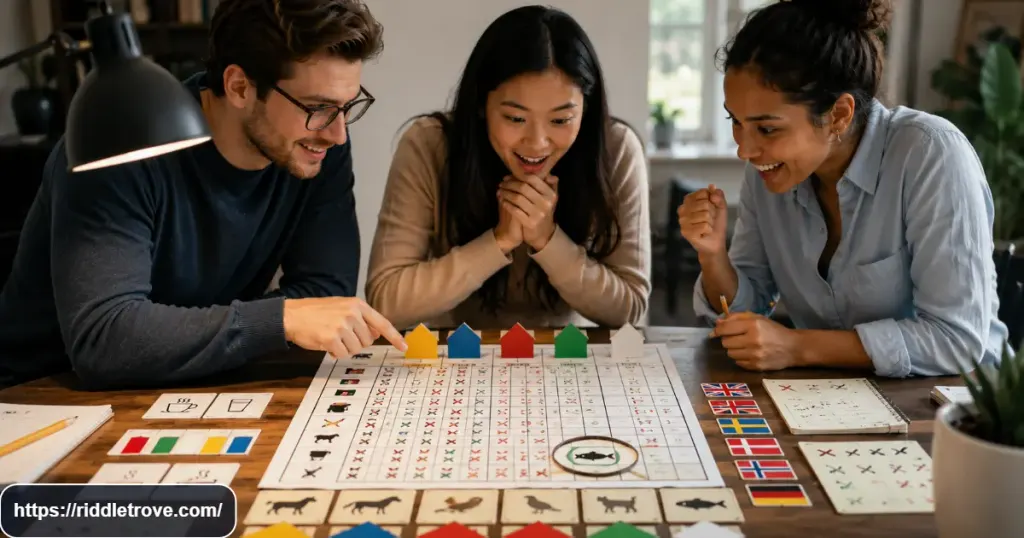
A blank 5×5 logic grid makes this puzzle much easier to manage.
Create five columns for the houses and match each category against them:
| House | Nationality | Color | Drink | Cigarette | Pet |
|---|---|---|---|---|---|
| 1 | ? | ? | ? | ? | ? |
| 2 | ? | ? | ? | ? | ? |
| 3 | ? | ? | ? | ? | ? |
| 4 | ? | ? | ? | ? | ? |
| 5 | ? | ? | ? | ? | ? |
Start with clues that give you an exact position.
Clue 8 tells you that House 3 drinks milk.
Clue 14 says the Norwegian lives next to the blue house. Since the Norwegian is in House 1, House 2 must be blue.
From there, the remaining clues begin to interact.
If you want to solve it without spoilers, stop here and work through the grid before continuing.
Einstein’s Riddle Answer: Who Owns the Fish? 🐟
Answer: The German owns the fish.
The completed arrangement is:
| House | Nationality | Color | Drink | Cigarette | Pet |
|---|---|---|---|---|---|
| 1 | Norwegian | Yellow | Water | Dunhill | Cats |
| 2 | Danish | Blue | Tea | Blend | Horse |
| 3 | British | Red | Milk | Pall Mall | Birds |
| 4 | German | Green | Coffee | Prince | Fish |
| 5 | Swedish | White | Beer | BlueMaster | Dogs |
So the famous answer is:
The German owns the fish.
The answer isn’t based on a trick or lucky guess. Every placement follows from the constraints in the 15 clues.
How to Solve Einstein’s Riddle Step by Step 🧠
The easiest approach is to lock down the clues with fixed positions first.
Step 1: Place the Norwegian
Clue 9 says the Norwegian lives in House 1.
Step 2: Place milk
Clue 8 says the center house drinks milk.
Therefore, House 3 has milk.
Step 3: Find the blue house
Clue 14 says the Norwegian lives next to the blue house.
Since the Norwegian is in House 1, House 2 must be blue.
Step 4: Connect green and white
Clue 4 says the green house is immediately left of the white house.
Clue 5 says the green house serves coffee.
The remaining positions eventually force the pair into Houses 4 and 5:
- House 4 = green + coffee
- House 5 = white
Step 5: Place the yellow house
The yellow house belongs to the person who smokes Dunhill.
With House 2 already blue and the green/white pair fixed at Houses 4 and 5, House 1 becomes yellow.
Therefore:
House 1 = Norwegian + yellow + Dunhill.
Step 6: Place the horse
Clue 11 says the horse owner lives next to the Dunhill smoker.
Dunhill is in House 1, so the horse must be in House 2.
Step 7: Place the British person
The British person lives in the red house.
The remaining color/nationality combinations force:
House 3 = British + red.
Step 8: Place tea and Danish
The Danish person drinks tea.
With the remaining nationality and drink combinations, House 2 becomes:
Danish + blue + tea.
Step 9: Place birds and Pall Mall
Pall Mall goes with birds.
The remaining possibilities place both in House 3:
House 3 = Pall Mall + birds.
Step 10: Resolve Blend
The Blend smoker lives next to the person with cats and also has a neighbor who drinks water.
This combination forces:
House 2 = Blend
and House 1 = water.
Step 11: Place cats
Since the Blend smoker in House 2 must live next to the cat owner, and House 3 already has birds, the cats go in:
House 1.
Step 12: Place beer and BlueMaster
BlueMaster is associated with beer.
The only remaining matching house is House 5:
House 5 = beer + BlueMaster.
Step 13: Place the Swedish person and dogs
Clue 2 says the Swedish person keeps dogs.
House 5 therefore becomes:
Swedish + dogs.
Step 14: Place the German
The German smokes Prince.
The remaining nationality and cigarette combination puts the German in House 4.
Step 15: The final deduction
House 4 has:
German + green + coffee + Prince
The only pet left is the fish.
Therefore:
The German owns the fish.
The Complete Einstein’s Riddle Solution Grid 📋
Here’s the finished solution in one place:
| House | 1 | 2 | 3 | 4 | 5 |
|---|---|---|---|---|---|
| Nationality | Norwegian | Danish | British | German | Swedish |
| Color | Yellow | Blue | Red | Green | White |
| Drink | Water | Tea | Milk | Coffee | Beer |
| Cigarette | Dunhill | Blend | Pall Mall | Prince | BlueMaster |
| Pet | Cats | Horse | Birds | Fish | Dogs |
This table is the easiest way to verify the final answer.
It also shows why the puzzle works: each category appears exactly once, and the relationships described by the clues are satisfied simultaneously.
Did Albert Einstein Really Create This Riddle? 📚
Despite its famous name, there is no solid evidence that Albert Einstein personally created the puzzle.
The attribution became part of the puzzle’s popular identity, but modern discussions of its history distinguish the legend from the documented record.
That distinction matters because the puzzle itself is real and well established even if the Einstein connection is uncertain.
So it’s safer to call it Einstein’s Riddle by its popular name rather than claim that Einstein definitely invented it.

Einstein’s Riddle vs. the Zebra Puzzle 🦓
The terms are often used interchangeably, but versions can differ.
The Zebra Puzzle commonly asks who owns the zebra, while the familiar Einstein’s Riddle version asks who owns the fish.
Both use the same basic style:
- five houses
- several matching categories
- logical constraints
- positional clues
- elimination
- one complete solution
The exact clues and labels can vary between versions, so always solve the specific version in front of you rather than mixing clues from different editions.
Why Is Einstein’s Riddle So Difficult? 🤔
The individual clues aren’t necessarily complicated.
The difficulty comes from combining them.
One clue can establish a position. That position then affects a neighboring clue, which eliminates another possibility, which unlocks a third category.
Three things make the puzzle particularly demanding:
- Several categories interact at once.
- Some clues depend on position rather than identity.
- A wrong early assumption can create contradictions later.
That’s why a logic grid is more reliable than trying to keep every possibility in your head.
Conclusion
Einstein’s Riddle is challenging because its solution emerges from a chain of small deductions rather than one clever trick. Once the houses, colors, drinks, cigarettes, nationalities, and pets are organized in a grid, the puzzle becomes much easier to reason through.
The famous answer is the German owns the fish, but the satisfying part is seeing why every other possibility gets eliminated. If you enjoyed this puzzle, logic-grid puzzles are a natural next step because they build the same habits of deduction, comparison, and careful elimination.
Frequently Asked Questions
What is Einstein’s Riddle?
Einstein’s Riddle is a classic five-house logic puzzle in which you match five nationalities, colors, drinks, cigarette brands, and pets using 15 clues.
What is the answer to Einstein’s Riddle?
In the classic fish version, the German owns the fish.
Who owns the fish in Einstein’s Riddle?
The German owns the fish.
Is Einstein’s Riddle the same as the Zebra Puzzle?
They are closely related and are often treated as the same puzzle family. Different versions can change the final question, names, and some clues.
Did Albert Einstein really create the riddle?
The attribution to Albert Einstein is popular but not firmly established. It is better treated as part of the puzzle’s history and popular legend than as a proven fact.
How do you solve Einstein’s Riddle?
Use a logic grid and begin with fixed-position clues, such as the Norwegian being in House 1 and milk being in House 3. Then use adjacency, color, drink, nationality, pet, and cigarette clues to eliminate possibilities.
How long does Einstein’s Riddle take to solve?
There is no universal solving time. A first attempt can take considerably longer than a familiar puzzle, especially without a grid. Experienced logic-puzzle solvers may work through it much faster.
Can you solve Einstein’s Riddle without guessing?
Yes. The classic version is designed to be solved through deduction and elimination rather than random guessing.