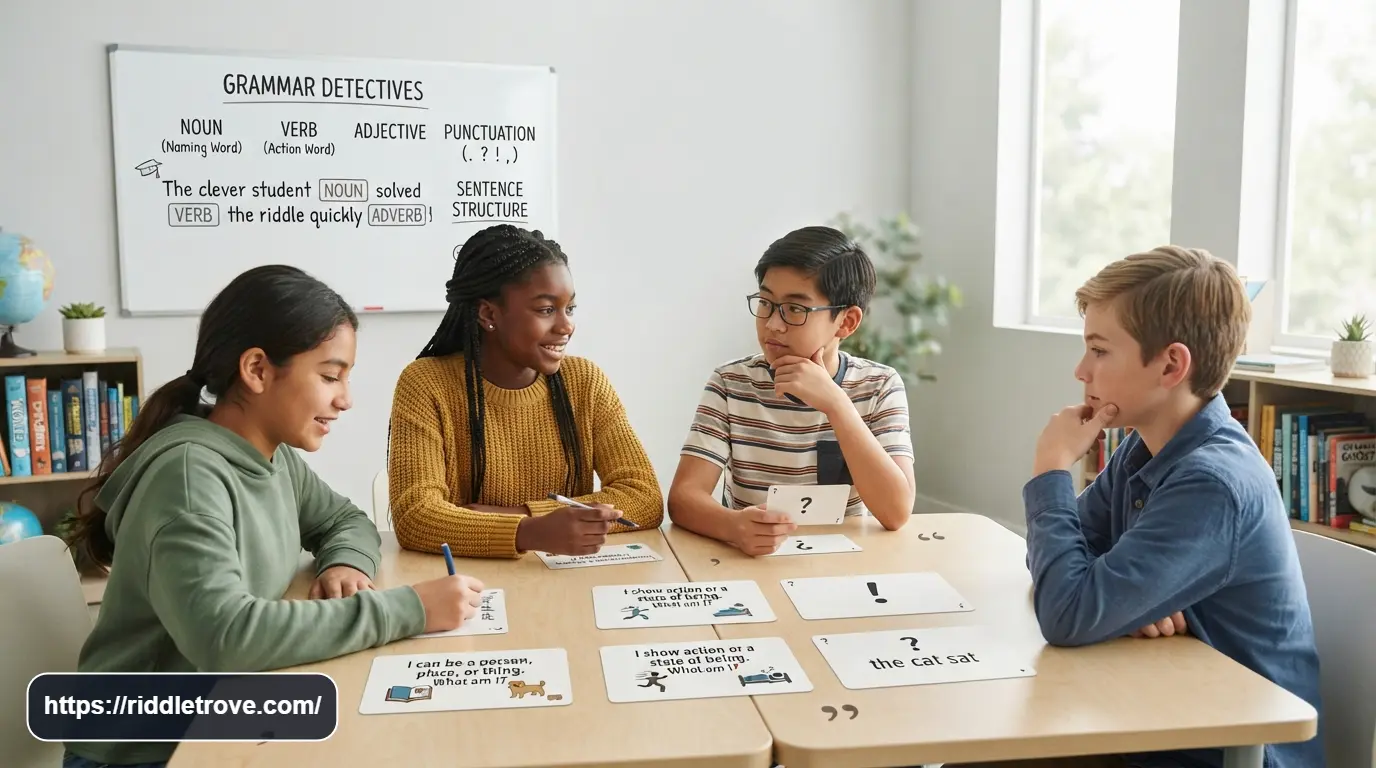
Grammar can feel much easier when you turn rules, words, and sentence patterns into puzzles. These grammar riddles with answers are designed to make learners think about parts of speech, punctuation, sentence structure, verbs, nouns, adjectives, and common grammar mistakes.
You’ll find 100 short riddles divided into 10 sections, with exactly 10 riddles in each H2. Start with easier clues, then work toward trickier grammar challenges. They can work for kids, students, teachers, classroom brain breaks, or anyone who enjoys testing their language skills.
Easy Grammar Riddles for Kids 🧒
Riddle 1: I name a person, place, or thing. What am I?
Answer: Noun
Riddle 2: I show an action like run or jump. What am I?
Answer: Verb
Riddle 3: I describe a noun. What am I?
Answer: Adjective
Riddle 4: I describe how an action happens. What am I?
Answer: Adverb
Riddle 5: I replace a noun like “he” or “they.” What am I?
Answer: Pronoun
Riddle 6: I join words like “and” and “but.” What am I?
Answer: Conjunction
Riddle 7: I show a relationship like “under” or “beside.” What am I?
Answer: Preposition
Riddle 8: I express sudden feeling. What am I?
Answer: Interjection
Riddle 9: I end many statements. What mark am I?
Answer: Period
Riddle 10: I can show a question. What mark am I?
Answer: Question mark
Noun and Pronoun Riddles 📚
Riddle 11: I can be a name, city, animal, or object. What am I?
Answer: Noun
Riddle 12: I stand in for “Maria” in “She smiled.” What am I?
Answer: Pronoun
Riddle 13: I name something you cannot touch, like freedom. What am I?
Answer: Abstract noun
Riddle 14: I name things you can count, like books. What am I?
Answer: Countable noun
Riddle 15: I can replace “Tom and I.” Who am I?
Answer: We
Riddle 16: I can replace “the students.” Who am I?
Answer: They
Riddle 17: I show ownership in “Sarah’s bag.” What do I show?
Answer: Possession
Riddle 18: I can replace “the dog” in “It barked.” What am I?
Answer: It
Riddle 19: I name something you can feel but not hold, like happiness. What am I?
Answer: Abstract noun
Riddle 20: I name one person, place, or thing. What number am I?
Answer: Singular
Verb and Tense Riddles ⏰
Riddle 21: I tell what someone does. What am I?
Answer: Verb
Riddle 22: I show an action happening now. What tense am I?
Answer: Present tense
Riddle 23: I show an action that already happened. What tense am I?
Answer: Past tense
Riddle 24: I show an action that will happen later. What tense am I?
Answer: Future tense
Riddle 25: In “She sings,” which word is the action?
Answer: Sings
Riddle 26: In “They walked,” what tells us it happened before now?
Answer: Walked
Riddle 27: I help another verb in “can swim.” What kind of verb am I?
Answer: Helping verb
Riddle 28: In “He is running,” which word names the action?
Answer: Running
Riddle 29: I can change from “go” to “went.” What am I?
Answer: Verb
Riddle 30: In “We will travel,” what word points to the future?
Answer: Will
Adjective and Adverb Riddles ✨
Riddle 31: I describe a noun like “bright” in “bright star.” What am I?
Answer: Adjective
Riddle 32: I describe a verb like “quickly.” What am I?
Answer: Adverb
Riddle 33: In “red apple,” which word describes the apple?
Answer: Red
Riddle 34: In “ran quickly,” which word describes the running?
Answer: Quickly
Riddle 35: I can describe size, color, or shape. What am I?
Answer: Adjective
Riddle 36: I often tell how, when, or where. What am I?
Answer: Adverb
Riddle 37: In “three books,” what kind of word is “three”?
Answer: Adjective
Riddle 38: In “very cold,” what word strengthens “cold”?
Answer: Very
Riddle 39: In “the noisy crowd,” which word describes the crowd?
Answer: Noisy
Riddle 40: In “spoke softly,” which word tells how?
Answer: Softly
Preposition and Conjunction Riddles 🔗
Riddle 41: I can show location in “under the table.” What am I?
Answer: Preposition
Riddle 42: I connect words with “and.” What am I?
Answer: Conjunction
Riddle 43: In “beside the door,” which word shows location?
Answer: Beside
Riddle 44: I can connect two choices with “or.” What am I?
Answer: Conjunction
Riddle 45: I can show direction in “toward home.” What am I?
Answer: Toward
Riddle 46: I connect ideas with “but.” What am I?
Answer: Conjunction
Riddle 47: In “between two chairs,” which word shows position?
Answer: Between
Riddle 48: I can connect two causes or ideas with “because.” What am I?
Answer: Conjunction
Riddle 49: In “across the street,” what word shows position?
Answer: Across
Riddle 50: I can join words, phrases, or clauses. What am I?
Answer: Conjunction
Robotics Riddles With Answers: 100 Fun, Clever & Tricky Puzzles
Punctuation Grammar Riddles ✍️
Riddle 51: I finish a normal statement. Who am I?
Answer: Period
Riddle 52: I end a direct question. Who am I?
Answer: Question mark
Riddle 53: I show strong feeling at the end. Who am I?
Answer: Exclamation mark
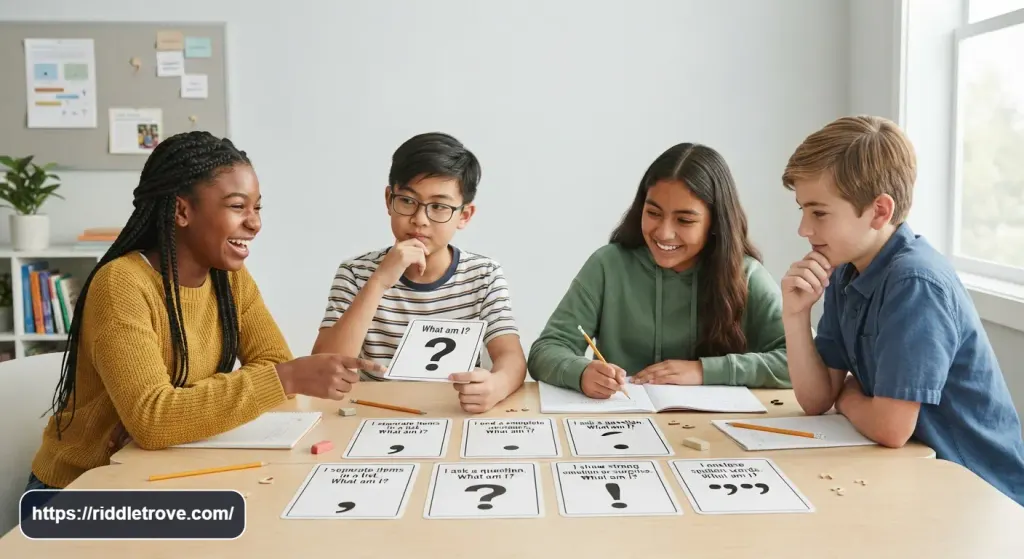
Riddle 54: I can separate items in a list. What am I?
Answer: Comma
Riddle 55: I can show missing letters in a contraction. What am I?
Answer: Apostrophe
Riddle 56: I can connect closely related complete thoughts. What am I?
Answer: Semicolon
Riddle 57: I can introduce a list after a complete thought. What am I?
Answer: Colon
Riddle 58: I can show a pause between parts of a sentence. What am I?
Answer: Comma
Riddle 59: I can appear around someone’s exact words. What am I?
Answer: Quotation marks
Riddle 60: I can show that words were shortened in “don’t.” What am I?
Answer: Apostrophe
Sentence Structure Riddles 🧩
Riddle 61: I usually tell who or what a sentence is about. What am I?
Answer: Subject
Riddle 62: I tell what the subject does or is. What am I?
Answer: Predicate
Riddle 63: In “Birds fly,” who is the subject?
Answer: Birds
Riddle 64: In “Birds fly,” what is the predicate?
Answer: Fly
Riddle 65: I contain a subject and a verb and can express a complete thought. What am I?
Answer: Independent clause
Riddle 66: I cannot usually stand alone as a complete thought. What am I?
Answer: Dependent clause
Riddle 67: I join two independent clauses with a conjunction. What am I?
Answer: Compound sentence
Riddle 68: I contain one independent clause. What am I?
Answer: Simple sentence
Riddle 69: I combine an independent clause with a dependent clause. What am I?
Answer: Complex sentence
Riddle 70: I am a group of words that works together but may lack a subject or verb. What am I?
Answer: Phrase
Funny Grammar Riddles 😄
Riddle 71: I have a subject, but I am not a school subject. What am I?
Answer: Sentence
Riddle 72: I have a predicate, but I never make a prediction. What am I?
Answer: Sentence
Riddle 73: I have a period, but I am not waiting for a bus. What am I?
Answer: Sentence
Riddle 74: I have a capital, but I am not a city. What am I?
Answer: Capital letter
Riddle 75: I have a clause, but I am not asking for a break. What am I?
Answer: Sentence
Riddle 76: I have a comma, but I am not taking a breath. What am I?
Answer: Sentence
Riddle 77: I can be active, but I never go to the gym. What am I?
Answer: Active voice
Riddle 78: I can be passive, but I am not sitting quietly. What am I?
Answer: Passive voice
Riddle 79: I can be irregular, but I am not badly behaved. What am I?
Answer: Irregular verb
Riddle 80: I have a tense, but I am not nervous. What am I?
Answer: Verb
Tricky Grammar Riddles 🧠
Riddle 81: In “She gave him a gift,” who receives the gift?
Answer: Him
Riddle 82: In “The cat chased the mouse,” who did the chasing?
Answer: The cat
Riddle 83: Which word is a pronoun: “quickly,” “they,” or “green”?
Answer: They
Riddle 84: Which word is an adjective: “bright,” “slowly,” or “jump”?
Answer: Bright
Riddle 85: Which word is an adverb: “happy,” “carefully,” or “teacher”?
Answer: Carefully
Riddle 86: In “Although it rained, we played,” which part depends on the other?
Answer: Although it rained
Riddle 87: In “Mia and Leo laughed,” what joins the two names?
Answer: And
Riddle 88: In “The book is on the desk,” what word shows position?
Answer: On
Riddle 89: In “Wow! That was close,” what type of word is “Wow”?
Answer: Interjection
Riddle 90: In “The tall boy ran quickly,” which word describes “boy”?
Answer: Tall
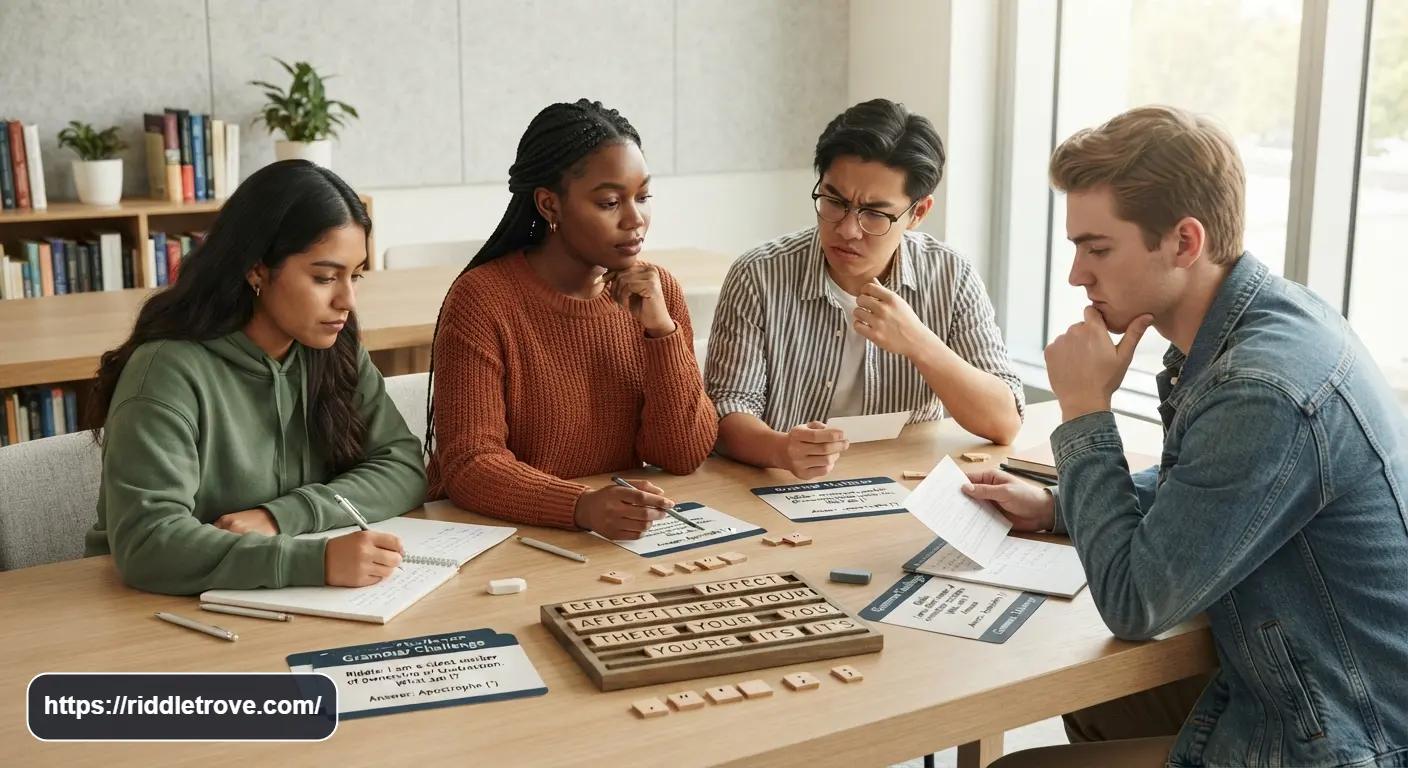
Hard Grammar Brain Teasers 🔥
Riddle 91: I can be “I,” “me,” “my,” or “mine.” What am I?
Answer: First-person pronoun
Riddle 92: I change “The dog chased the ball” so the ball becomes the focus. What voice am I?
Answer: Passive voice
Riddle 93: I join “I stayed” and “it rained” with “because.” What kind of word is “because”?
Answer: Subordinating conjunction
Riddle 94: I show who receives an action, as “her” does in “He called her.” What am I?
Answer: Object
Riddle 95: I describe the subject after a linking verb, as “happy” in “She is happy.” What am I?
Answer: Subject complement
Riddle 96: I can join two independent clauses with a semicolon. What am I?
Answer: Compound sentence
Riddle 97: I am “running” in “They are running.” What kind of verb form am I?
Answer: Present participle
Riddle 98: I show ownership without saying “of,” as in “the teacher’s desk.” What do I show?
Answer: Possession
Riddle 99: I describe a noun but never perform the noun’s action. What am I?
Answer: Adjective
Riddle 100: I can contain a subject, a verb, and a complete thought. What am I?
Answer: Sentence
Conclusion
These grammar riddles with answers turn common language rules into quick puzzles that are easier to practice and remember. Use the easier sections for warm-ups, the middle sections for classroom brain breaks, and the tricky riddles for a stronger grammar challenge. You can also hide the answers and solve each clue with a partner or group. The best grammar practice is active, so try explaining why each answer works after solving it.
Frequently Asked Questions
What are grammar riddles?
Grammar riddles are short puzzles built around language rules, parts of speech, punctuation, sentence structure, and related grammar concepts.
Are grammar riddles good for kids?
Yes. Short grammar riddles can help kids practice basic language concepts while making review more interactive.
What grammar topics can riddles teach?
They can cover nouns, pronouns, verbs, adjectives, adverbs, conjunctions, prepositions, punctuation, sentence structure, and verb tenses.
Can teachers use grammar riddles in class?
Yes. Teachers can use them as warm-ups, review activities, bell-ringers, or short brain breaks.
Are these grammar riddles suitable for students?
The easier sections are especially suitable for students learning basic grammar, while the later sections provide more challenging practice.
How can I make grammar riddles harder?
Use less obvious clues, combine two grammar concepts, add sentence-analysis challenges, or require solvers to identify a word’s grammatical role.
What is the difference between a grammar riddle and a grammar question?
A grammar riddle usually uses clues, wordplay, or a puzzle-like setup, while a standard grammar question may simply ask the learner to recall or apply a rule.
Can grammar riddles help with parts of speech?
Yes. Riddles can give learners repeated practice identifying nouns, verbs, pronouns, adjectives, adverbs, conjunctions, and other parts of speech.
1 thought on “Grammar Riddles With Answers: 100 Fun Brain Teasers”