
Calculus can look intimidating when symbols, limits, derivatives, and integrals start filling the page. But a good calculus riddle can turn those ideas into a quick reasoning challenge. These calculus riddles with answers use short clues about functions, rates of change, graphs, limits, derivatives, and integrals.
The first sections begin with accessible calculus concepts, then move toward harder puzzles involving derivatives, optimization, and infinite processes. Try solving each riddle before checking the answer.
Easy Calculus Riddles 📘
Riddle 1: I measure how fast something changes. What am I?
Answer: Derivative
Riddle 2: I ask what happens as you get closer and closer. What am I?
Answer: Limit
Riddle 3: I add tiny pieces into one total. What am I?
Answer: Integral
Riddle 4: I can have an input and produce an output. What am I?
Answer: Function
Riddle 5: I show a curve’s rise, fall, and shape. What am I?
Answer: Graph
Riddle 6: I tell where a curve crosses the vertical axis. What am I?
Answer: Y-intercept
Riddle 7: I tell where a graph crosses the horizontal axis. What am I?
Answer: X-intercept
Riddle 8: I stay unchanged while other values move. What am I?
Answer: Constant
Riddle 9: I am the value you put into a function. What am I?
Answer: Input
Riddle 10: I am what a function gives back. What am I?
Answer: Output
Derivative Riddles With Answers 📈
Riddle 11: I describe a curve’s slope at one point. What am I?
Answer: Instantaneous rate
Riddle 12: I am the derivative of x². What am I?
Answer: 2x
Riddle 13: I am the derivative of x³. What am I?
Answer: 3x²
Riddle 14: I am the derivative of x⁴. What am I?
Answer: 4x³
Riddle 15: I am the derivative of x. What am I?
Answer: 1
Riddle 16: I am the derivative of a constant. What am I?
Answer: Zero
Riddle 17: I can tell whether a function rises or falls. What am I?
Answer: First derivative
Riddle 18: I am the derivative of sin x. What am I?
Answer: cos x
Riddle 19: I am the derivative of cos x. What am I?
Answer: -sin x
Riddle 20: I am the derivative of eˣ. What am I?
Answer: eˣ
Limit Riddles 🔍
Riddle 21: I care about where you are heading, not where you started. What am I?
Answer: Limit
Riddle 22: I can exist even when a function is missing a point. What am I?
Answer: Limit value
Riddle 23: I approach a number forever without necessarily reaching it. What am I?
Answer: Convergence
Riddle 24: I describe behavior near a point. What am I?
Answer: Local behavior
Riddle 25: I am the value approached from the left side. What am I?
Answer: Left-hand limit
Riddle 26: I am the value approached from the right side. What am I?
Answer: Right-hand limit
Riddle 27: When both sides approach the same value, I exist. What am I?
Answer: Two-sided limit
Riddle 28: I grow without bound near certain inputs. What kind of behavior am I?
Answer: Infinite behavior
Riddle 29: I can describe what happens as x becomes enormous. What am I?
Answer: Limit at infinity
Riddle 30: I am a tiny distance used to describe approaching. What am I?
Answer: Infinitesimal

Integral Calculus Riddles ∫
Riddle 31: I reverse differentiation. What am I?
Answer: Antiderivative
Riddle 32: I can find the accumulated area under a curve. What am I?
Answer: Definite integral
Riddle 33: I give an antiderivative without fixed endpoints. What am I?
Answer: Indefinite integral
Riddle 34: I remind you that an indefinite integral has many answers. What am I?
Answer: Constant of integration
Riddle 35: I split a region into tiny pieces before adding them. What method am I?
Answer: Riemann sum
Riddle 36: I use rectangles to estimate area. What am I?
Answer: Rectangle approximation
Riddle 37: I use the middle of each interval for height. What am I?
Answer: Midpoint rule
Riddle 38: I use the left endpoint for height. What am I?
Answer: Left Riemann sum
Riddle 39: I use the right endpoint for height. What am I?
Answer: Right Riemann sum
Riddle 40: I connect derivatives and integrals in one powerful theorem. What am I?
Answer: Fundamental Theorem of Calculus
Calculus Wordplay Riddles 🧠
Riddle 41: I am always changing, yet calculus loves to measure me. What am I?
Answer: Variable
Riddle 42: I am the letter often used for a tiny change in calculus. What am I?
Answer: Delta
Riddle 43: I wear a prime mark after differentiation. What am I?
Answer: Function derivative
Riddle 44: I can mean “with respect to” in a derivative. What symbol am I?
Answer: dx
Riddle 45: I am a curve with no sharp corner at my smooth points. What am I?
Answer: Smooth function
Riddle 46: I am a line that touches a curve at one point. What am I?
Answer: Tangent line
Riddle 47: I cross a curve and often compare two points. What line am I?
Answer: Secant line
Riddle 48: I describe how steep a line is. What am I?
Answer: Slope
Riddle 49: I am where a function’s output stops increasing and starts decreasing. What point am I?
Answer: Local maximum
Riddle 50: I am where a function’s output stops decreasing and starts increasing. What point am I?
Answer: Local minimum
100 Geometry Riddles With Answers: Easy, Funny, Tricky & Hard
Funny Calculus Riddles 😄
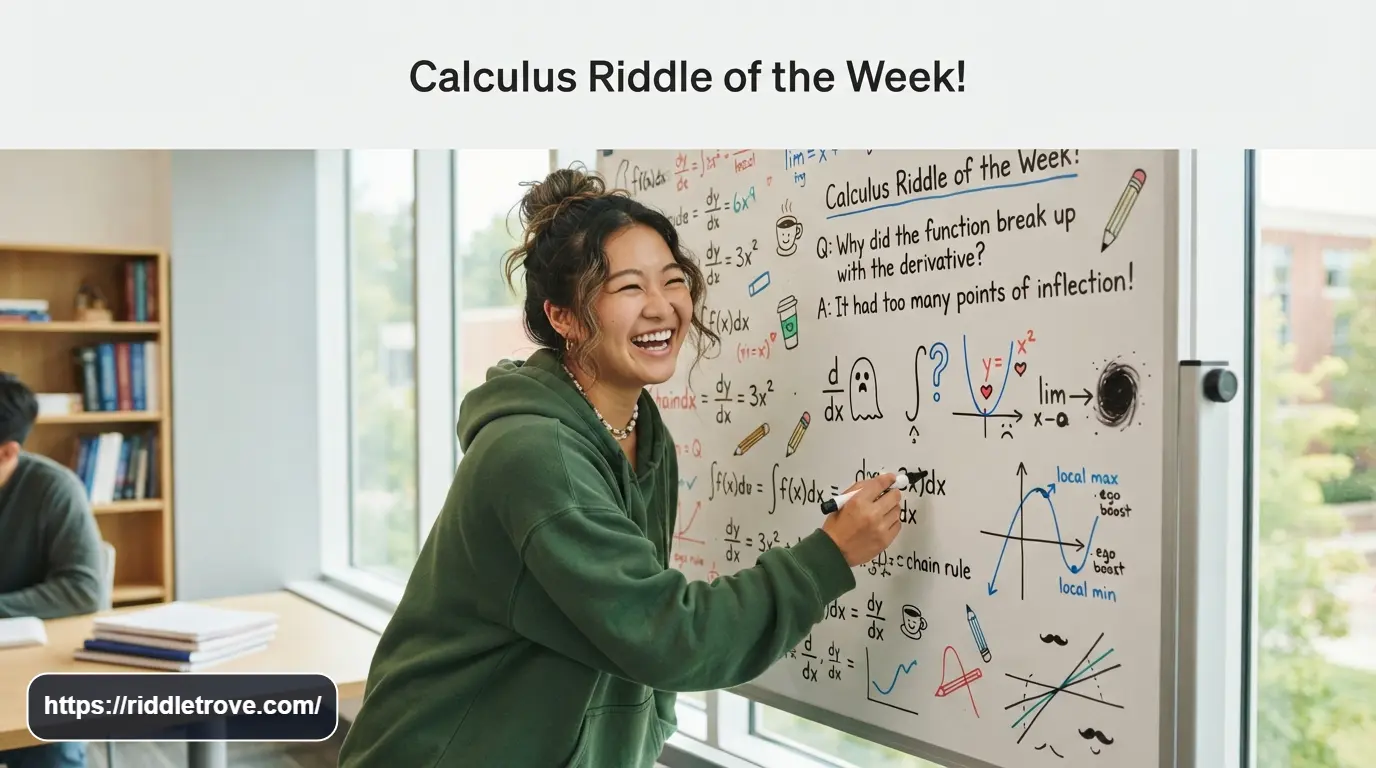
Riddle 51: Why did the derivative break up with the function?
Answer: It needed some space to change.
Riddle 52: What does a calculus student call a tiny mistake?
Answer: A small error
Riddle 53: Why was the tangent line so confident?
Answer: It knew exactly where it touched.
Riddle 54: Why did the integral bring a calculator?
Answer: It had a lot to add up.
Riddle 55: Why did the limit never panic?
Answer: It was always approaching the answer.
Riddle 56: Why did the constant stay calm?
Answer: It never changed.
Riddle 57: Why did the function go to therapy?
Answer: It had too many variables.
Riddle 58: Why was the graph invited to the party?
Answer: It knew how to connect the points.
Riddle 59: Why did the secant line keep traveling?
Answer: It liked passing through points.
Riddle 60: Why did the calculus student love elevators?
Answer: They understood rates of change.
Hard Calculus Riddles 🧩
Riddle 61: My derivative is zero everywhere. What kind of function could I be?
Answer: Constant function
Riddle 62: My slope is positive, but my curve bends downward. What am I describing?
Answer: Increasing concavity-down function
Riddle 63: My slope changes from positive to negative. What point may I mark?
Answer: Local maximum
Riddle 64: My slope changes from negative to positive. What point may I mark?
Answer: Local minimum
Riddle 65: I have a derivative of zero, but I am not automatically a maximum. What am I?
Answer: Critical point
Riddle 66: I tell whether a graph bends upward or downward. What am I?
Answer: Second derivative
Riddle 67: My second derivative is positive. Which way do I bend?
Answer: Concave up
Riddle 68: My second derivative is negative. Which way do I bend?
Answer: Concave down
Riddle 69: I am a point where concavity can change. What am I?
Answer: Inflection point
Riddle 70: I help find extreme values on a closed interval. What theorem am I?
Answer: Extreme Value Theorem
Calculus Riddles for Students 🎓
Riddle 71: I tell how a position changes over time. What am I?
Answer: Velocity
Riddle 72: I tell how velocity changes over time. What am I?
Answer: Acceleration
Riddle 73: I am the derivative of position. What am I?
Answer: Velocity function
Riddle 74: I am the derivative of velocity. What am I?
Answer: Acceleration function
Riddle 75: I can turn a rate into a total change. What process am I?
Answer: Integration
Riddle 76: I can turn position into velocity. What operation am I?
Answer: Differentiation
Riddle 77: I compare actual change with change in the input. What am I?
Answer: Average rate of change
Riddle 78: I describe change at one exact instant. What am I?
Answer: Instantaneous rate of change
Riddle 79: I help solve maximum and minimum problems. What topic am I?
Answer: Optimization
Riddle 80: I describe a quantity that depends on another quantity. What am I?
Answer: Dependent variable
Calculus Riddles for Kids 🔢
Riddle 81: I move along a graph but never leave its curve. What am I?
Answer: Point
Riddle 82: I tell which way a line rises or falls. What am I?
Answer: Direction of slope
Riddle 83: I am a number that never changes in a simple function. What am I?
Answer: Fixed value
Riddle 84: I can show how far something travels over time. What graph am I?
Answer: Distance-time graph
Riddle 85: I can show speed changing over time. What graph am I?
Answer: Velocity-time graph
Riddle 86: I am a curve’s steepness at one exact spot. What am I?
Answer: Tangent slope
Riddle 87: I collect many tiny changes into one result. What am I?
Answer: Accumulation
Riddle 88: I am a graph with a missing point. What feature might I have?
Answer: Removable discontinuity
Riddle 89: I describe a break or jump in a graph. What am I?
Answer: Discontinuity
Riddle 90: I am a smooth path with no sudden break. What am I?
Answer: Continuous curve
Tricky Calculus Riddles 🧠

Riddle 91: A function rises while its slope gets smaller. What is its concavity?
Answer: Concave down
Riddle 92: A function falls while its slope becomes more negative. What is its concavity?
Answer: Concave down
Riddle 93: A function falls, but its slope becomes less negative. What is its concavity?
Answer: Concave up
Riddle 94: A function rises and its slope becomes more positive. What is its concavity?
Answer: Concave up
Riddle 95: If f′(x) changes from + to −, what happens at the critical point?
Answer: Local maximum
Riddle 96: If f′(x) changes from − to +, what happens at the critical point?
Answer: Local minimum
Riddle 97: If f′(x) stays positive on an interval, what does f do?
Answer: Increases
Riddle 98: If f′(x) stays negative on an interval, what does f do?
Answer: Decreases
Riddle 99: If f′′(x) changes from positive to negative, what happens?
Answer: Concavity changes from up to down
Riddle 100: I am the calculus idea behind finding the best possible value. What am I?
Answer: Optimization
Conclusion
These calculus riddles with answers turn core ideas such as limits, derivatives, integrals, slopes, functions, and optimization into quick brain teasers. Start with the easier clues, then work toward the harder calculus riddles without checking the answers too soon. They can work as classroom warm-ups, study breaks, review activities, or quick challenges for students learning calculus. For an extra challenge, cover the answers and try solving ten riddles in a row before checking your results.
Frequently Asked Questions
What are calculus riddles?
Calculus riddles are short puzzles built around calculus concepts such as limits, derivatives, integrals, functions, slopes, and optimization.
Are calculus riddles good for students?
Yes. Short calculus riddles can make review more engaging while encouraging students to recall concepts and reason through clues.
What are some easy calculus riddles?
Easy calculus riddles can focus on familiar concepts such as functions, constants, limits, derivatives, graphs, and integrals.
What are hard calculus riddles?
Hard calculus riddles usually require multiple connected ideas, such as interpreting derivatives, analyzing concavity, or reasoning about critical points.
Can kids solve calculus riddles?
Some introductory calculus riddles can be adapted for younger learners, especially those involving graphs, patterns, rates, and simple mathematical ideas.
How can I use calculus riddles in class?
Teachers can use them as warm-ups, exit-ticket activities, review questions, bell ringers, or short group challenges.
What is the difference between a calculus riddle and a calculus problem?
A calculus problem usually asks you to perform a mathematical procedure. A calculus riddle adds clues, wordplay, or a reasoning twist to reach the answer.
How can I make calculus riddles harder?
Use layered clues, critical-point reasoning, concavity, limits, related rates, optimization, or problems that require more than one reasoning step.