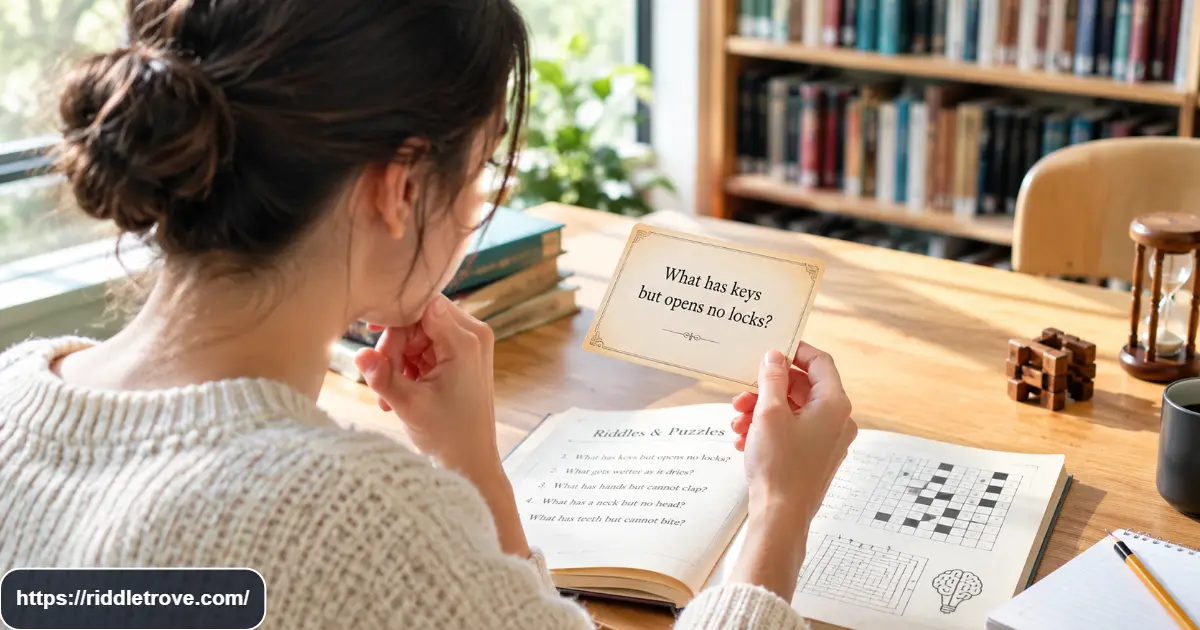
If you have searched for riddle me this meaning, you may have seen the phrase used before a tricky.Q question, clever observation, or playful challenge. It sounds like a traditional riddle, but its meaning is actually broader than simply asking someone to solve a puzzle.
“Riddle me this” generally means “answer this tricky question” or “try to explain this.” Depending on the situation, it can sound curious, humorous, challenging, or sarcastic.
This guide explains the meaning of riddle me this, riddle me, and riddle me that, while also covering the related words riddled and riddled with. To make the topic more useful, each riddle section includes exactly 10 short riddles with answers.
What Does “Riddle Me This” Mean? 🧩
“Riddle me this” is a phrase used to introduce a riddle, puzzle, difficult question, or surprising situation. In simple English, it can mean “Can you figure this out?” or “Can you explain this to me?”
The phrase does not always introduce a traditional riddle with a hidden answer. Someone might say “riddle me this” before asking a question that seems strange, contradictory, or difficult to explain.
For example:
“Riddle me this: If the store is closed, why are the lights still on?”
Here, the speaker is not necessarily asking for a classic word puzzle. They are challenging someone to explain something puzzling.
10 Short Riddles
Riddle 1: What has keys but opens no locks?
Answer: A piano.
Riddle 2: What gets wetter as it dries?
Answer: A towel.
Riddle 3: What has hands but cannot clap?
Answer: A clock.
Riddle 4: What has teeth but cannot bite?
Answer: A comb.
Riddle 5: What has one eye but cannot see?
Answer: A needle.
Riddle 6: What has a neck but no head?
Answer: A bottle.
Riddle 7: What has words but never speaks?
Answer: A book.
Riddle 8: What has legs but cannot walk?
Answer: A table.
Riddle 9: What can travel worldwide from one corner?
Answer: A stamp.
Riddle 10: What has a face and two hands?
Answer: A clock.
What Does “Riddle Me” Mean? 🤔
“Riddle me” is a shorter expression connected to the same idea. It can mean asking someone to solve, explain, or make sense of something.
The exact meaning depends on what follows it. In casual speech, it often creates a playful challenge.
For example, someone might say, “Riddle me why he left early,” meaning, “Can you explain why he left early?”
The expression is informal and works best in conversation, humor, entertainment, and casual writing. It would usually sound unusual in a formal business report.
10 Short Riddles
Riddle 11: What has a thumb and four fingers?
Answer: A glove.
Riddle 12: What has a head and a tail but no body?
Answer: A coin.
Riddle 13: What has many rings but no fingers?
Answer: A tree.
Riddle 14: What comes down but never goes up?
Answer: Rain.
Riddle 15: What has a bed but never sleeps?
Answer: A river.
Riddle 16: What has cities but no houses?
Answer: A map.
Riddle 17: What has an ear but cannot hear?
Answer: A cup.
Riddle 18: What runs but never walks?
Answer: Water.
Riddle 19: What has bark but cannot bite?
Answer: A tree.
Riddle 20: What has a spine but no bones?
Answer: A book.
What Does “Riddle Me That” Mean? 🔍
“Riddle me that” usually means “explain that to me” or “figure that one out.” It can be used after mentioning something confusing, surprising, or difficult to explain.
There is a small difference in conversational direction:
- Riddle me this usually introduces something you are about to ask.
- Riddle me that often points back to something that has already been mentioned or observed.
For example:
“The train left five minutes early. Riddle me that.”
The speaker is challenging the listener to explain the unusual situation.

10 Short Riddles
Riddle 21: What can you catch but not throw?
Answer: A cold.
Riddle 22: What has a ring but no finger?
Answer: A telephone.
Riddle 23: What has branches but no leaves?
Answer: A bank.
Riddle 24: What has a mouth but cannot eat?
Answer: A river.
Riddle 25: What has a tongue but cannot taste?
Answer: A shoe.
Riddle 26: What fills a room but takes no space?
Answer: Light.
Riddle 27: What breaks when you say its name?
Answer: Silence.
Riddle 28: What goes up when rain comes down?
Answer: An umbrella.
Riddle 29: What gets shorter as it grows older?
Answer: A candle.
Riddle 30: What has a head but no brain?
Answer: A nail.
Riddle Me This vs. Riddle Me That 🧠
The expressions “riddle me this” and “riddle me that” are closely related. Both can introduce a challenge or request for an explanation.
The main distinction is grammatical and conversational rather than a completely different dictionary meaning.
“Riddle me this” normally introduces a new question:
“Riddle me this: Why does ice float?”
“Riddle me that” often refers to something already presented:
“The answer makes no sense. Riddle me that.”
Both expressions can be humorous. Tone matters greatly. A friendly speaker may use them jokingly, while someone making a criticism may use them sarcastically.
10 Short Riddles
Riddle 31: What has four wheels and flies?
Answer: A garbage truck.
Riddle 32: What has holes but holds water?
Answer: A sponge.
Riddle 33: What begins with T and ends with T?
Answer: A teapot.
Riddle 34: What has four legs but cannot walk?
Answer: A chair.
Riddle 35: What can be cracked but never held?
Answer: A joke.
Riddle 36: What has a bottom at the top?
Answer: Your legs.
Riddle 37: What has a bark and grows tall?
Answer: A tree.
Riddle 38: What has a foot but no legs?
Answer: A ruler.
Riddle 39: What has a lock but no door?
Answer: Hair.
Riddle 40: What has no beginning or end?
Answer: A circle.
How Do You Use “Riddle Me This”? 💬
The phrase is most natural when you want to make a question sound playful, mysterious, challenging, or humorous.
It can be followed by a traditional riddle:
“Riddle me this: What has a face but no eyes?”
It can also introduce a real-world question:
“Riddle me this: Why does everyone arrive early when the meeting starts late?”
In casual conversation, the phrase adds personality. It signals that the speaker thinks the question deserves some thought.
You can also use it in social posts, jokes, puzzles, games, and informal articles.
10 Short Riddles
Riddle 41: What room has no doors?
Answer: A mushroom.
Riddle 42: What has one foot and no legs?
Answer: A ruler.
Riddle 43: What kind of tree fits in your hand?
Answer: A palm.
Riddle 44: What has an eye but cannot see?
Answer: A storm.
Riddle 45: What has ears but cannot hear?
Answer: Corn.
Riddle 46: What has a face but no eyes?
Answer: A clock.
Riddle 47: What can be opened but has no door?
Answer: A book.
Riddle 48: What has a head and a foot?
Answer: A bed.
Riddle 49: What can run without legs?
Answer: A river.
Riddle 50: What has pages but no voice?
Answer: A book.
Is “Riddle Me This” Sarcastic? 😏
It can be sarcastic, but sarcasm is not part of the phrase’s basic meaning.
The tone depends on the speaker and situation. A person can use “riddle me this” sincerely when presenting a difficult puzzle. Another person can use exactly the same words sarcastically when pointing out an obvious contradiction.
Compare these:
Playful:
“Riddle me this: What has four legs but cannot walk?”
Sarcastic:
“You said the restaurant is closed, but you’re eating there right now. Riddle me this.”
The second example uses the phrase to highlight an inconsistency rather than to ask a traditional riddle.

10 Short Riddles
Riddle 51: What has many teeth but cannot chew?
Answer: A zipper.
Riddle 52: What can fly without wings?
Answer: Time.
Riddle 53: What can fall but never break?
Answer: Night.
Riddle 54: What can break without falling?
Answer: A promise.
Riddle 55: What has a heart but no organs?
Answer: An artichoke.
Riddle 56: What has a crown but no king?
Answer: A tooth.
Riddle 57: What has a sole but no soul?
Answer: A shoe.
Riddle 58: What has a handle but no door?
Answer: A mug.
Riddle 59: What has a screen but no cinema?
Answer: A phone.
Riddle 60: What has a cap but no head?
Answer: A bottle.
Where Did “Riddle Me This” Come From? 📚
The phrase belongs to the broader tradition of presenting a puzzle or difficult question as a challenge. Its structure is based on the verb riddle, which can relate to posing or solving a puzzling question.
Over time, “riddle me this” became recognizable as a conversational formula. Popular culture helped make the expression even more familiar, especially through the Batman character known as the Riddler.
Today, the phrase can be used without any connection to Batman. People use it simply to make a question sound clever or challenging.
10 Short Riddles
Riddle 61: What has no bones but can bend?
Answer: A branch.
Riddle 62: What has a ring and makes a sound?
Answer: A bell.
Riddle 63: What has a point but cannot argue?
Answer: A pencil.
Riddle 64: What has a handle and a blade?
Answer: A knife.
Riddle 65: What has a lid but no box?
Answer: An eye.
Riddle 66: What has a frame but no picture?
Answer: A bicycle.
Riddle 67: What has a key but no lock?
Answer: A keyboard.
Riddle 68: What has a line but cannot write?
Answer: A fishing rod.
Riddle 69: What has a wheel but cannot drive?
Answer: A bicycle.
Riddle 70: What has a shell but no beach?
Answer: An egg.
What Does “Riddle Me This, Batman” Mean? 🦇
“Riddle me this, Batman” is strongly associated with the Riddler, one of Batman’s best-known villains. The character is famous for presenting puzzles, clues, and questions to Batman.
Because of that association, people sometimes use the phrase jokingly when they want to imitate the Riddler’s dramatic style.
However, “riddle me this” does not require a Batman reference. The ordinary expression can be used independently in everyday English.
10 Short Riddles
Riddle 71: What has a mask but no face?
Answer: A costume.
Riddle 72: What has a cape but cannot fly?
Answer: A book.
Riddle 73: What has a web but is not online?
Answer: A spider.
Riddle 74: What has a bat but no cave?
Answer: A baseball player.
Riddle 75: What has clues but no detective?
Answer: A crossword.
Riddle 76: What can hide in plain sight?
Answer: A clue.
Riddle 77: What is full of puzzles but has no voice?
Answer: A puzzle book.
Riddle 78: What has a secret but cannot speak?
Answer: A locked box.
Riddle 79: What can be solved but is not a problem?
Answer: A riddle.
Riddle 80: What can be tricky without being difficult?
Answer: A clue.
What Does “Riddled” Mean? 📝
The word “riddled” has meanings that are related to, but different from, the phrase “riddle me this.”
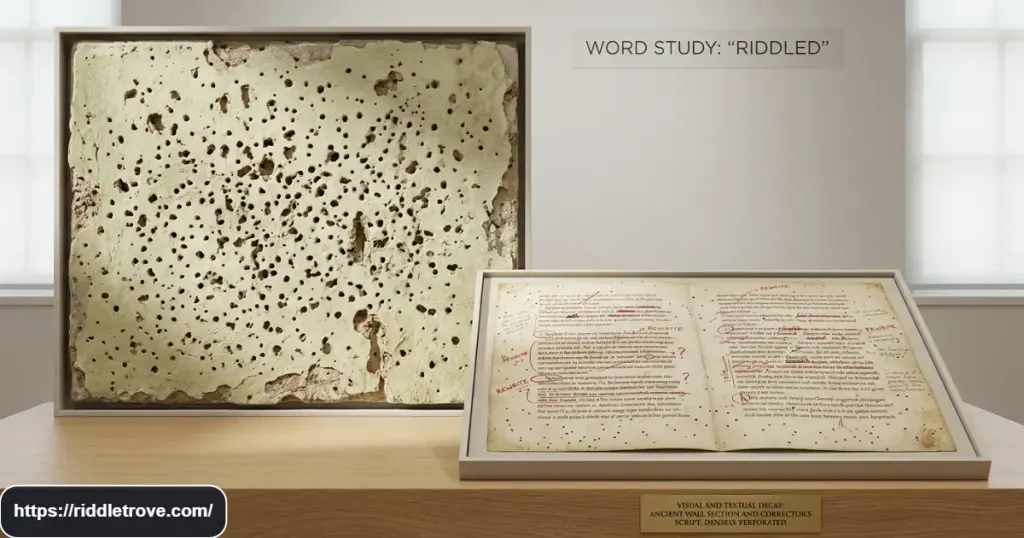
When something is described as riddled, it can mean that it contains many holes or is heavily affected by something. For example, a wall can be riddled with holes.
“Riddled” can also appear in descriptions of something filled with problems:
“The report was riddled with errors.”
Here, the word means the report contained many errors.
This is different from saying “riddle me this,” which is an expression used to introduce a question or challenge.
10 Short Riddles
Riddle 81: What has holes and lets air through?
Answer: A net.
Riddle 82: What has cracks but still holds a tune?
Answer: A record.
Riddle 83: What has spots but is not sick?
Answer: A dice.
Riddle 84: What has marks but cannot read?
Answer: A ruler.
Riddle 85: What has lines but no handwriting?
Answer: A notebook.
Riddle 86: What has scratches but cannot feel?
Answer: A record.
Riddle 87: What has dents but cannot complain?
Answer: A can.
Riddle 88: What has stains but cannot wash itself?
Answer: A shirt.
Riddle 89: What has holes but is not broken?
Answer: Swiss cheese.
Riddle 90: What can be full of mistakes?
Answer: A draft.
What Does “Riddled With” Mean? 🔎
“Riddled with” means full of something, especially something negative or undesirable.
For example:
- “The article was riddled with errors.”
- “The old wall was riddled with holes.”
- “The plan was riddled with problems.”
The phrase usually suggests that the thing contains many examples of the problem being described.
This meaning is separate from the conversational phrase “riddle me this.” Although both contain the word “riddle,” they serve different grammatical purposes.
10 Short Riddles
Riddle 91: What is full of holes but useful?
Answer: A colander.
Riddle 92: What is full of keys but has no doors?
Answer: A keyboard.
Riddle 93: What is full of numbers but cannot count?
Answer: A calendar.
Riddle 94: What is full of letters but cannot read?
Answer: A mailbox.
Riddle 95: What is full of stars but not the sky?
Answer: A rating chart.
Riddle 96: What is full of words but cannot talk?
Answer: A dictionary.
Riddle 97: What is full of roads but has no cars?
Answer: A map.
Riddle 98: What is full of dates but never ages?
Answer: A calendar.
Riddle 99: What is full of pictures but cannot see?
Answer: An album.
Riddle 100: What is full of stories but cannot speak?
Answer: A library.
Riddle vs. Riddled: What’s the Difference? ⚖️
The words riddle and riddled look similar, but they can function differently.
A riddle is commonly a puzzling question or problem that requires an answer. For example:
“Can you solve this riddle?”
Riddled is commonly used to describe something filled with holes, problems, errors, or another undesirable feature:
“The document was riddled with mistakes.”
The phrase “riddle me this” uses “riddle” as part of a verbal expression meaning “try to answer or explain this.”
Understanding the context makes the difference easy to recognize.
10 Short Riddles
Riddle 101: What asks a question but expects an answer?
Answer: A riddle.
Riddle 102: What has a problem but no feelings?
Answer: A puzzle.
Riddle 103: What has an answer but cannot ask?
Answer: A question card.
Riddle 104: What can be tricky but has a solution?
Answer: A puzzle.
Riddle 105: What can be read upside down?
Answer: Some numbers.
Riddle 106: What can be counted but never touched?
Answer: Time.
Riddle 107: What has a solution but no lock?
Answer: A problem.
Riddle 108: What can be answered without speaking?
Answer: A written question.
Riddle 109: What can challenge your mind without moving?
Answer: A puzzle.
Riddle 110: What can have clues and an answer?
Answer: A riddle.
Conclusion
The phrase “riddle me this” is a playful way to introduce a tricky question, puzzle, or surprising thought. It often invites someone to stop, think, and try to figure something out. Depending on the tone, it can sound curious, humorous, teasing, or even slightly sarcastic.
It is also important to distinguish “riddle me this” from “riddled” and “riddled with.” While “riddle me this” introduces a question or puzzle, “riddled with” means filled with something, usually something negative, such as errors, problems, or holes.
Whether you are solving funny riddles, challenging brain teasers, or simply wondering what “riddle me this” means, understanding the phrase makes its everyday use much clearer. Next time someone says, “Riddle me this,” you know they are inviting you to think—and hopefully come up with the answer.
Frequently Asked Questions
What is the simplest riddle me this meaning?
The simplest meaning is “Can you solve or explain this?” It is a playful way to introduce a difficult question, puzzle, or surprising observation.
Is “riddle me this” a real phrase?
Yes. It is an established informal expression used to introduce a riddle, tricky question, or challenge.
Is “riddle me this” formal English?
No. It is generally conversational and playful. It is better suited to casual speech, entertainment, humor, and informal writing than highly formal communication.
Does “riddle me this” always mean a riddle?
No. The phrase can introduce an ordinary question if the speaker wants to make that question sound puzzling or challenging.
What does “riddle me that” mean?
“Riddle me that” usually means “explain that” or “figure that out.” It often refers to something already mentioned or observed.
What does “riddled” mean?
“Riddled” can mean filled with holes or heavily affected by something. It is also commonly used for things containing many problems or flaws.
What does “riddled with” mean?
“Riddled with” means full of something, especially something undesirable, such as errors, problems, or holes.
Is “riddle me this” sarcastic?
It can be sarcastic, but it is not automatically sarcastic. The speaker’s tone and the situation determine whether it sounds serious, playful, teasing, or sarcastic.
Why do people say “riddle me this, Batman”?
The phrase is associated with the Riddler, a Batman villain known for challenging Batman with riddles and puzzles. People also use it humorously outside the Batman context.
Can I use “riddle me this” before a joke?
Yes. It can introduce a joke, clever observation, wordplay, or question designed to make someone think.
Is “riddle me this” the same as “guess what”?
Not exactly. “Guess what?” usually introduces a piece of news or information, while “riddle me this” suggests that the listener should solve or explain something.
What is the difference between riddle and riddled?
A riddle is commonly a puzzle or puzzling question. Riddled can describe something filled with holes, errors, problems, or another repeated feature.
Can “riddle me this” be used in writing?
Yes. It works well in informal articles, social posts, jokes, puzzle books, dialogue, and creative writing. It may sound too casual for some formal documents.
What does “riddled with errors” mean?
It means that something contains many errors. For example, “The report was riddled with errors” means the report had numerous mistakes.
What makes a good short riddle?
A good short riddle should have clear wording, fair clues, a logical answer, and enough information for the reader to solve it without relying on an arbitrary interpretation.