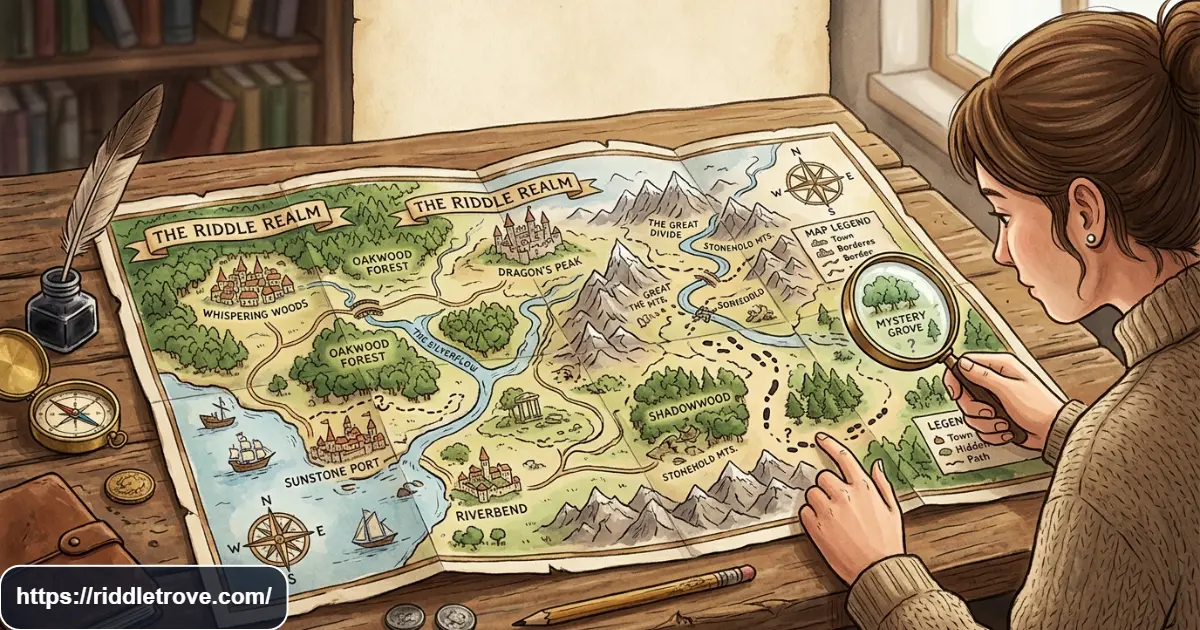
The “I have cities but no houses” riddle sounds like it describes a strange place, but the trick is that the clues are not meant literally. The answer is something that can show cities, forests, roads, and rivers without actually containing the real things.
If you want to solve it yourself, start with the clues before looking at the answer. The hints below move from subtle to obvious, so you can stop as soon as you think you’ve figured it out.
This article also includes short related riddles with different answers, so you can keep testing the same kind of lateral-thinking skill without reading dozens of variations that all lead to the same solution.
The “I Have Cities but No Houses” Riddle 🗺️
Riddle 1:
I have cities but no houses, forests but no trees, and water but no fish. What am I?
Answer: A map.
Riddle 2:
I show streets but have no cars. What am I?
Answer: A map.
Riddle 3:
I show mountains but have no rocks. What am I?
Answer: A map.
Riddle 4:
I can show countries without containing people. What am I?
Answer: A map.
Riddle 5:
I show rivers, but my water never flows. What am I?
Answer: A map.
Riddle 6:
I can show your town without holding a single house. What am I?
Answer: A map.
Riddle 7:
I have roads but no traffic. What am I?
Answer: A map.
Riddle 8:
I can show a forest without growing a tree. What am I?
Answer: A map.
Riddle 9:
I can show borders without needing guards. What am I?
Answer: A map.
Riddle 10:
I can guide you through places I’ve never visited. What am I?
Answer: A map.
The classic answer is a map because a map represents real places without physically containing them. Cities appear as names, lines, or symbols, while the actual houses, trees, water, and people remain in the real world.
Short Representation Riddles 🔎
Riddle 11:
I show your face but never smile. What am I?
Answer: A photograph.
Riddle 12:
I copy your words without speaking. What am I?
Answer: A recording.
Riddle 13:
I show the world but fit in your hand. What am I?
Answer: A globe.
Riddle 14:
I tell a story with pictures, but I cannot speak. What am I?
Answer: A comic.
Riddle 15:
I show the past but never age. What am I?
Answer: A photograph.
Riddle 16:
I can hold thousands of stories without having a voice. What am I?
Answer: A book.
Riddle 17:
I show where you are without knowing your name. What am I?
Answer: A location pin.
Riddle 18:
I repeat your appearance without being you. What am I?
Answer: A mirror.
Riddle 19:
I can represent a building without being a building. What am I?
Answer: A blueprint.
Riddle 20:
I can show a journey before it begins. What am I?
Answer: An itinerary.
These riddles use a similar idea to the original: something can represent, record, reflect, or describe something else without actually being that thing. That shift in perspective is often what makes short riddles surprisingly tricky.
More Short Logic & What-Am-I Riddles 🧩
Riddle 21:
The more you take, the more you leave behind. What are they?
Answer: Footsteps.
Riddle 22:
I get wetter as I dry you. What am I?
Answer: A towel.
Riddle 23:
I have keys but open no locks. What am I?
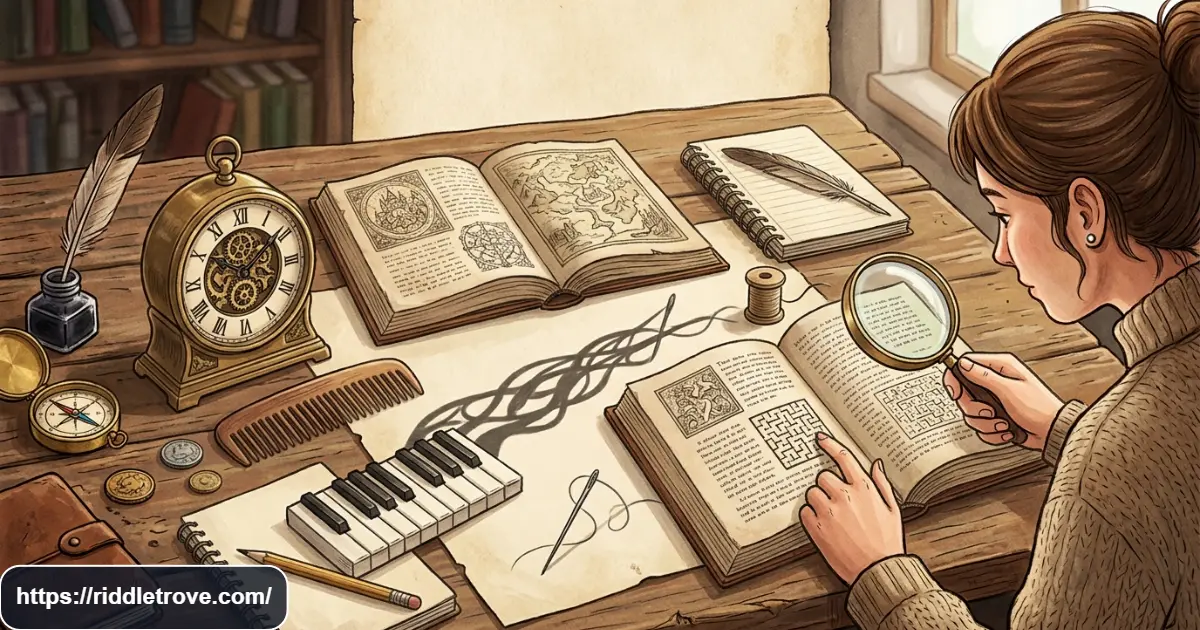
Answer: A piano.
Riddle 24:
I have hands but cannot clap. What am I?
Answer: A clock.
Riddle 25:
I have one eye but cannot see. What am I?
Answer: A needle.
Riddle 26:
I speak without a mouth and answer when spoken to. What am I?
Answer: An echo.
Riddle 27:
I become shorter every time I work. What am I?
Answer: A pencil.
Riddle 28:
I have teeth but cannot bite. What am I?
Answer: A comb.
Riddle 29:
I follow you by day but vanish at night. What am I?
Answer: A shadow.
Riddle 30:
I have pages but cannot read. What am I?
Answer: A book.
Hints for the I Have Cities but No Houses Riddle 💡
If you’re solving the original riddle, don’t focus only on the word “cities.” Think about something that can show a city without physically containing it.
Hint 1: You can use me when traveling.
Hint 2: I can show roads, rivers, and mountains.
Answer: A map.
Why Is the Answer a Map?
The wording works because each clue describes something that a map can represent.
- Cities: A map can label or mark cities.
- Houses: It can show where houses or buildings are located without containing them.
- Forests: Forests can be marked with symbols or shaded areas.
- Trees: The map represents the forest rather than containing real trees.
- Water: Rivers, lakes, and oceans can be drawn or marked.
- Fish: The map can show water locations without containing actual fish.
The trick is therefore about representation rather than physical possession. Once you stop imagining a literal container filled with cities and forests, the answer becomes much easier to see.
Different Versions of the Riddle 🌎
The famous riddle appears in several forms. Some versions use “mountains but no rocks”, while others mention “rivers but no water.” The wording changes, but the intended answer remains a map because maps can represent all of these geographical features.
Riddle 31:
I show mountains without stones. What am I?
Answer: A map.
Riddle 32:
I show rivers without flowing water. What am I?
Answer: A map.
Riddle 33:
I show countries without citizens. What am I?
Answer: A map.
Riddle 34:
I show roads without vehicles. What am I?
Answer: A map.
Riddle 35:
I show islands without beaches. What am I?
Answer: A map.
Riddle 36:
I show oceans without waves. What am I?
Answer: A map.
Riddle 37:
I show borders without walls. What am I?
Answer: A map.
Riddle 38:
I show towns without people. What am I?
Answer: A map.
Riddle 39:
I show lakes without boats. What am I?
Answer: A map.
Riddle 40:
I show continents without crossing them. What am I?
Answer: A map.
These are useful for understanding the original mechanism, but they should not be mistaken for forty different answers. They all rely on the same central idea: a map represents real-world places and features without physically containing them.
Common Wrong Answers to the Riddle 🤔
The answer map is the standard solution, but a few alternatives can seem plausible at first.
Riddle 41:
I show the Earth in a round shape. What am I?
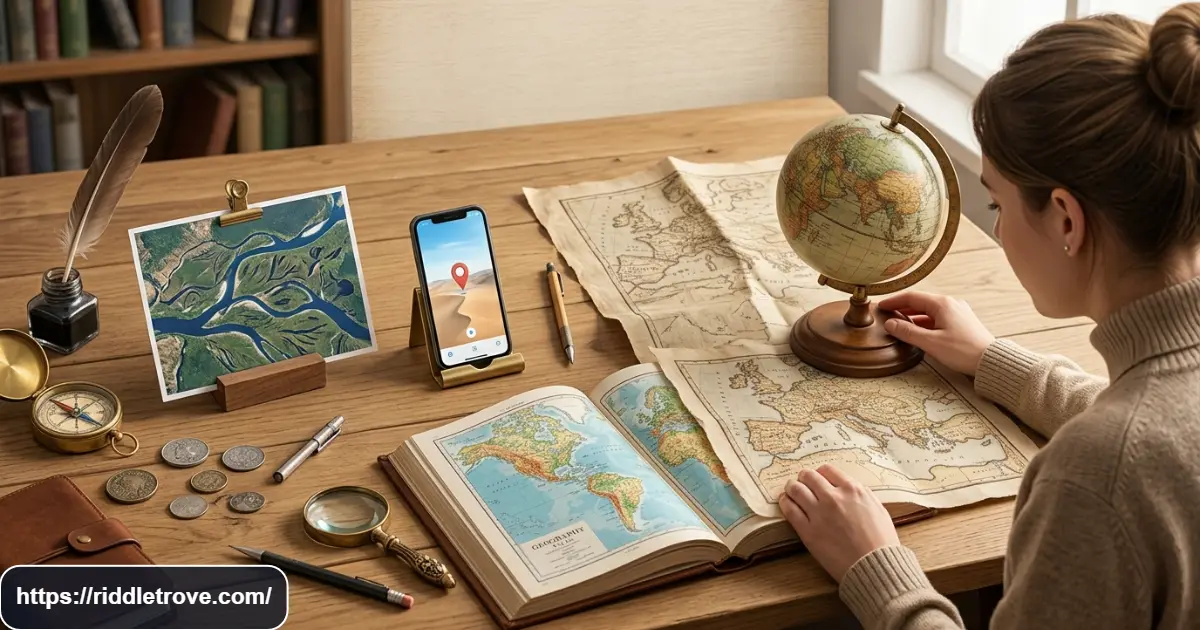
Answer: A globe.
Riddle 42:
I contain maps in a collection of pages. What am I?
Answer: An atlas.
Riddle 43:
I show streets and buildings from above. What am I?
Answer: An aerial photograph.
Riddle 44:
I show places through satellite images. What am I?
Answer: A satellite image.
Riddle 45:
I give directions but cannot walk. What am I?
Answer: A navigation app.
Riddle 46:
I mark a place but cannot travel there. What am I?
Answer: A location pin.
Riddle 47:
I can show a route without moving. What am I?
Answer: A route map.
Riddle 48:
I can describe a place without containing it. What am I?
Answer: A description.
Riddle 49:
I can display an entire city on a screen. What am I?
Answer: A digital map.
Riddle 50:
I can show where two places are without moving either one. What am I?
Answer: A map.
The globe and atlas are related ideas, but they are not as precise as the standard answer. The wording of the classic riddle points most naturally to a map because a map can display cities, forests, roads, rivers, and other geographical features in a symbolic form.
How to Solve Riddles Like This 🧠
When a riddle seems impossible, check whether its clues are using words in a non-literal way.
Start with these questions:
- Is the object representing something?
- Does it show something rather than contain it?
- Could the clues describe symbols or pictures?
- Do all the clues fit the same answer?
- Is the riddle asking about a physical object or its representation?
For the “I have cities but no houses” riddle, the key is the word “have.” A map does not physically possess cities. Instead, it shows and represents them.
That small change in interpretation is the entire trick.
Similar Short Riddles to Try 🧩
Riddle 51:
I can be cracked, made, told, and played. What am I?
Answer: A joke.
Riddle 52:
I have a neck but no head. What am I?
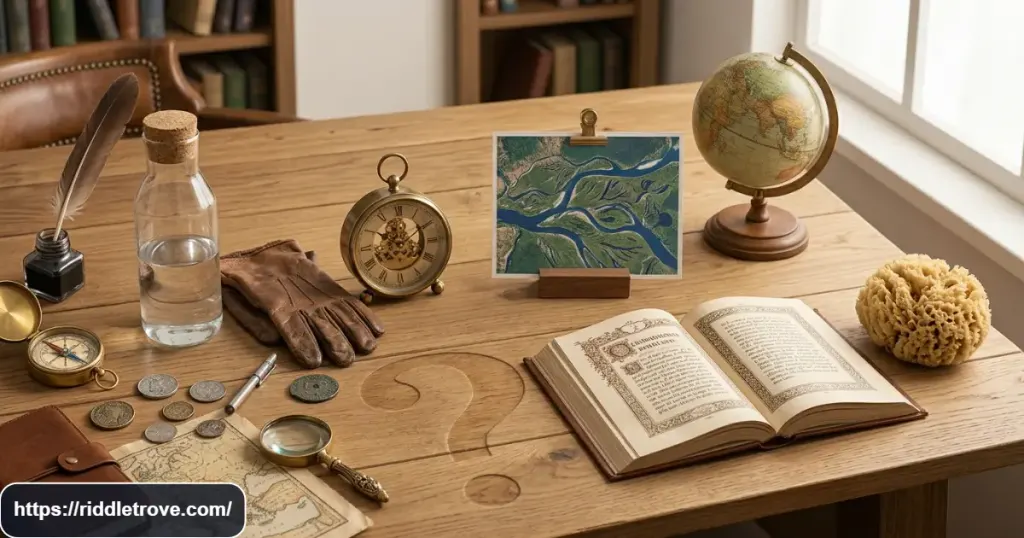
Answer: A bottle.
Riddle 53:
I have a thumb and four fingers but no hand. What am I?
Answer: A glove.
Riddle 54:
I have a bed but never sleep. What am I?
Answer: A river.
Riddle 55:
I have a head and a tail but no body. What am I?
Answer: A coin.
Riddle 56:
I have a face and two hands but no arms. What am I?
Answer: A clock.
Riddle 57:
I can run but never walk. What am I?
Answer: Water.
Riddle 58:
I have words but never speak. What am I?
Answer: A book.
Riddle 59:
I have branches but no leaves. What am I?
Answer: A bank.
Riddle 60:
I am full of holes but hold water. What am I?
Answer: A sponge.
These classic-style riddles use different answers and mechanisms, so they provide more variety than simply repeating the original map puzzle with slightly different geographical clues.
Conclusion
The “I have cities but no houses” riddle has a simple but effective trick: the clues describe things that can be represented rather than physically contained. The answer is a map, which can show cities, forests, mountains, roads, and water without containing the real objects. The best way to solve similar riddles is to question literal assumptions and test whether one answer explains every clue. Once you recognize that pattern, many seemingly impossible riddles become much easier to unravel.
Frequently Asked Questions
What is the answer to the “I have cities but no houses” riddle?
The standard answer is a map. It can show cities, forests, rivers, roads, and other geographical features without physically containing them.
What is a hint for the “I have cities but no houses” riddle?
Think of something used for navigation. It can show cities and other places without containing the real buildings or people.
Why is the answer a map?
A map is a representation of real places. It can display cities, forests, rivers, mountains, roads, and borders through names, lines, colors, and symbols.
What does “forests but no trees” mean?
It means a map can represent the location of a forest without containing any actual trees.
What does “water but no fish” mean?
A map can show rivers, lakes, and oceans, but the water and fish themselves are not physically present on the map.
Could the answer be a globe?
A globe can also represent cities and geographical features, so it is related to the idea. However, a map is the standard answer to the classic wording.
Could the answer be an atlas?
An atlas contains maps, so it can represent cities and geographical features. Still, map is the more direct answer to the original riddle.
Is this riddle suitable for kids?
Yes. The vocabulary and reasoning are simple enough for many children, while the non-literal interpretation gives the puzzle a useful thinking challenge.
What is the main trick behind this riddle?
The trick is understanding representation versus reality. The map “has” cities only in the sense that it shows or represents them.
How can I solve similar riddles?
Look for words that may not be literal. Ask whether the answer could represent, describe, reflect, or show the things mentioned in the clues.
1 thought on “I Have Cities but No Houses Riddle: Answer, Hints & More”