A simple clock can hide a surprisingly tricky counting puzzle. The question “How many numbers are on a clock?” seems to have an obvious answer, but the wording makes you look twice at what is actually being counted.
If you answered 12, you are thinking about the twelve numbered hour positions on a traditional clock face. The trickier version counts the individual digits used to write 1 through 12, which gives a different result. This article explores that famous riddle along with more short clock, counting, logic, and wordplay challenges.
Take your time with each one. Try solving it before checking the answer, especially when a question seems almost too easy.
The Original Clock Number Riddle 🕒
Riddle 1: How many numbers are on a clock?
Answer: 15
Riddle 2: What number comes after 9 on a clock?
Answer: 10
Riddle 3: How many digits are in 12?
Answer: 2
Riddle 4: How many digits are in 10?
Answer: 2
Riddle 5: How many digits are in 11?
Answer: 2
Riddle 6: Count the digits from 1 to 9. How many?
Answer: 9
Riddle 7: What comes after 11 on a standard clock?
Answer: 12
Riddle 8: How many numbered positions does a standard clock have?
Answer: 12
Riddle 9: What makes the clock riddle tricky?
Answer: The counting method
Riddle 10: What number looks like two digits but marks one hour?
Answer: 10
The famous clock riddle works because “numbers” can make you think about the twelve hour labels first. A traditional clock face shows 1 through 12, so 12 is the natural answer.
The trick comes from counting the individual digits used to write those labels. Numbers 1 through 9 use nine digits altogether. Then 10, 11, and 12 each use two digits. That adds six more digits, giving 15 individual digit occurrences.
So, for the intended trick interpretation:
1–9 = 9 digits
10 = 2 digits
11 = 2 digits
12 = 2 digits
Total = 15
Short Clock Counting Riddles 🔢
Riddle 11: How many hours are on a standard clock face?
Answer: 12
Riddle 12: What is the first number on a clock?
Answer: 1
Riddle 13: What is the last number on a standard clock?
Answer: 12
Riddle 14: How many digits does 9 have?
Answer: 1
Riddle 15: How many digits does 10 have?
Answer: 2
Riddle 16: How many digits does 11 have?
Answer: 2
Riddle 17: How many digits does 12 have?
Answer: 2
Riddle 18: Which clock number has two identical digits?
Answer: 11
Riddle 19: Which clock number is written with the most digits?
Answer: 10, 11, and 12
Riddle 20: What is halfway around a 12-hour clock?
Answer: 6 hours
Counting riddles become more interesting when the wording changes slightly. “How many numbers?” and “How many digits?” may sound similar, but they ask you to count different things.
That small distinction is exactly why the clock puzzle can catch people off guard. A good riddle does not always require complicated math. Sometimes the real challenge is deciding what the question means before you start counting.
Tricky Clock Face Riddles 🧩
Riddle 21: What has hands but cannot clap?
Answer: A clock
Riddle 22: What has a face but cannot smile?
Answer: A clock
Riddle 23: What moves but stays in place?
Answer: Clock hands
Riddle 24: What points but never speaks?
Answer: A clock hand
Riddle 25: What circles all day without walking?
Answer: A clock hand
Riddle 26: What has two hands and a face?
Answer: A clock
Riddle 27: What goes around without leaving?
Answer: A clock hand
Riddle 28: What tells time without talking?
Answer: A clock
Riddle 29: What has hands but no fingers?
Answer: A clock
Riddle 30: What has a face and two hands?
Answer: A clock
Clock face riddles often rely on familiar features that are normally easy to overlook. A clock can have a face, hands, numbers, and moving parts, but none of those features work like their human counterparts.
The best short riddles use that familiar language to create a second meaning. The clue sounds ordinary until you connect it to the answer. These puzzles are especially useful as quick brain breaks because they can be solved in just a few seconds.
Tricky Number and Time Riddles ⏰
Riddle 31: What number is between 11 and 13?
Answer: 12
Riddle 32: What number comes before 12?
Answer: 11
Riddle 33: What number comes after 10?
Answer: 11
Riddle 34: How many hours are in half a day?
Answer: 12
Riddle 35: How many minutes are in one hour?
Answer: 60
Riddle 36: How many seconds are in one minute?
Answer: 60
Riddle 37: What number sits opposite 12?
Answer: 6
Riddle 38: What number sits opposite 3?
Answer: 9
Riddle 39: What number sits opposite 1?
Answer: 7
Riddle 40: What number sits opposite 2?
Answer: 8
Not every time riddle needs a hidden trick. Some work through quick observation, number relationships, or knowledge of a standard clock face.
The opposite-number riddles are easiest when you picture the clock as a circle. Twelve sits at the top, six at the bottom, three on the right, and nine on the left. Once you visualize those positions, the answers become much easier to find.
Wordplay Clock Riddles 🔤
Riddle 41: What has hands but no arms?
Answer: A clock
Riddle 42: What has a face but no eyes?
Answer: A clock
Riddle 43: What can tick without a heartbeat?
Answer: A clock
Riddle 44: What can run without legs?
Answer: A clock
Riddle 45: What has a second but no second body?
Answer: A clock
Riddle 46: What can lose time without getting tired?
Answer: A clock
Riddle 47: What can gain time without moving?
Answer: A clock
Riddle 48: What has hands that never hold anything?
Answer: A clock
Riddle 49: What has a face that never changes expression?
Answer: A clock
Riddle 50: What can be right or wrong without speaking?
Answer: A clock
Wordplay works especially well with clocks because everyday language gives us expressions such as “clock hands,” “clock face,” “running clock,” and “losing time.” The words sound natural, but the riddle asks you to interpret them literally.
When solving these, look for words that could describe both a clock and something else. That double meaning is often the key.
Final Clock Riddle Challenge 🕵️
Riddle 51: A clock shows 12 numbers. How many digits are written?
Answer: 15
Riddle 52: If you count only unique digits from 1 to 12, how many are there?
Answer: 10
Riddle 53: What has 12 labels but 15 digit occurrences?
Answer: A standard clock face
Riddle 54: If you remove 10, 11, and 12, how many clock numbers remain?
Answer: 9
Riddle 55: If a clock has numbers 1 through 12, how many labels have two digits?
Answer: 3
Riddle 56: How many one-digit numbers appear on a standard clock?
Answer: 9
Riddle 57: How many two-digit numbers appear on a standard clock?
Answer: 3
Riddle 58: Add the digits used by 10, 11, and 12. What do you get?
Answer: 6
Riddle 59: Add 9 one-digit labels to 6 more digit occurrences. What is the total?
Answer: 15
Riddle 60: Which answer fits the trick riddle: 12 or 15?
Answer: 15
The final challenge focuses on the exact counting idea behind the original puzzle. There are 12 numbered hour labels on a traditional clock, but the written labels contain 15 individual digit occurrences.
That distinction is important. Saying there are 12 numbers is the natural answer when you mean the numbered hour positions. Saying there are 15 is the intended answer when the riddle asks you to count the individual digits appearing in those labels.
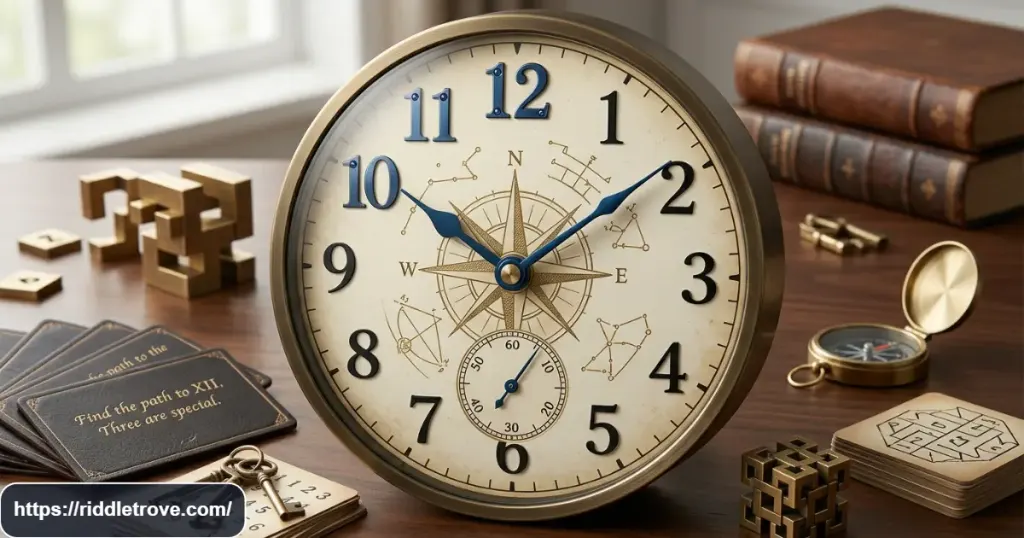
Why Is the Clock Riddle Answer 15?
The answer 15 comes from counting the written digits rather than simply counting the hour positions.
Numbers 1 through 9 each contain one digit, giving 9 digits.
The remaining clock labels are 10, 11, and 12. Each contains two digits:
- 10 = 2 digits
- 11 = 2 digits
- 12 = 2 digits
That gives another 6 digits.
So the calculation is:
9 + 2 + 2 + 2 = 15
This is why 15 is commonly given as the trick answer.
Why Do Some People Answer 12?
The answer 12 is understandable because a standard analog clock has twelve numbered hour positions.
If the question means, “How many numbered hour markers are on a clock face?” then 12 is the straightforward answer.
The riddle changes the interpretation by focusing on the individual digits used to write the numbers from 1 through 12. Under that interpretation, the count is 15.
So the two answers come from two different ways of counting:
12 = numbered hour positions
15 = individual digit occurrences
That distinction is what gives the riddle its trick.
How to Solve Similar Counting Riddles
When a riddle asks “how many,” do not immediately start counting. First decide exactly what the question wants you to count.
Look for words such as:
- numbers
- digits
- letters
- symbols
- objects
- appearances
- unique items
A small wording difference can completely change the result.
For clock riddles, picture the clock face and then inspect the labels individually. If the puzzle seems too obvious, check whether the wording is asking for a different unit. That extra moment of attention can reveal the intended trick.
Conclusion
The how many numbers are on a clock riddle is a simple example of how wording can change a puzzle’s answer. A standard clock has 12 numbered hour positions, which makes 12 a natural response. The trick version asks you to count the individual digits written from 1 through 12, producing 15. The calculation is simple, but the challenge comes from noticing what should actually be counted. The related clock riddles above use the same skills of observation, counting, wordplay, and careful reading to create quick challenges you can solve alone or share with friends and family.
Frequently Asked Questions
How many numbers are on a clock riddle answer?
The intended trick answer is 15 when counting the individual digit occurrences from 1 through 12.
Why is the clock riddle answer 15?
Numbers 1 through 9 contribute 9 digits, while 10, 11, and 12 contribute 6 more digits. The total is 15.
Why do some people say 12?
A standard analog clock has 12 numbered hour positions, so 12 is the natural answer when counting the clock’s labels.
How many digits are on a standard clock?
If you count every digit used in the labels 1 through 12, there are 15 digit occurrences.
How many unique digits appear from 1 to 12?
There are 10 unique digits, from 0 through 9.
Is 15 technically counting numbers or digits?
The trick interpretation counts individual digits, not 15 separate clock numbers. The wording is what creates the puzzle.
What is the trick in the clock riddle?
The trick is switching from counting the 12 hour labels to counting every individual digit used to write those labels.
Is the clock riddle a math riddle?
It uses simple counting, but the main challenge is interpretation and careful reading rather than difficult mathematics.