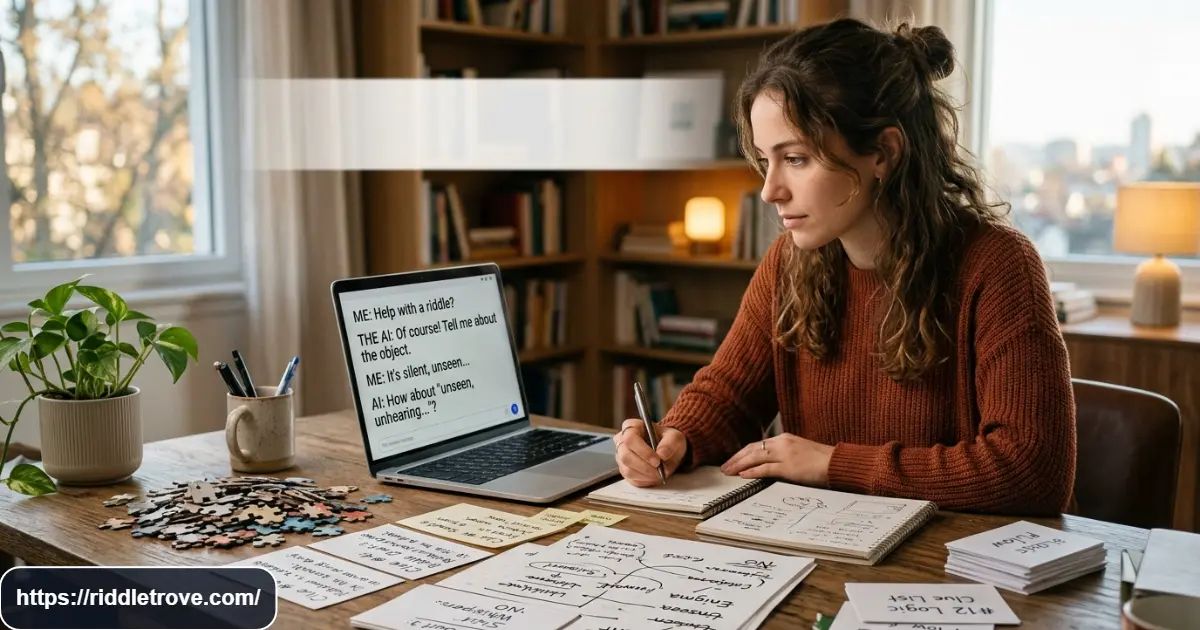
Need help creating riddles but not sure how to turn an idea into a clever puzzle? The easiest method is to start with the answer, list its unusual traits, and turn those traits into short clues.
You can also use an AI bot to brainstorm clues, test different difficulty levels, or improve wording. The key is to edit the result so the answer is fair, the clues make sense, and the riddle feels satisfying to solve.
How to Create a Good Riddle 🧩
A strong riddle gives enough information to solve it without revealing the answer too quickly. Start with something familiar, find its less obvious qualities, and hide the answer behind clever wording.
Here are 10 short examples to show how concise clues can work:
Riddle 1:
I have a face but never smile.
Answer: Clock
Riddle 2:
I follow you but never lead.
Answer: Shadow
Riddle 3:
I have keys but open no doors.
Answer: Piano
Riddle 4:
I get smaller as I work.
Answer: Pencil
Riddle 5:
I have pages but cannot read.
Answer: Book
Riddle 6:
I speak without a mouth.
Answer: Echo
Riddle 7:
I have hands but cannot clap.
Answer: Clock
Riddle 8:
I can be cracked without breaking.
Answer: Joke
Riddle 9:
I have one eye but cannot see.
Answer: Needle
Riddle 10:
I travel far while staying still.
Answer: Stamp
When creating your own, avoid simply listing obvious facts. Look for an unusual connection that makes the solver pause.
Start With the Answer ✏️
One of the simplest ways to create a riddle is to choose the answer first. Then brainstorm details that could describe it indirectly.
Try this formula:
Answer → Traits → Unusual clue → Misdirection → Question
For example, suppose your answer is umbrella. Instead of saying, “I protect you from rain,” think about less direct clues.
Riddle 11:
I open when clouds arrive.
Answer: Umbrella
Riddle 12:
I have a handle but no suitcase.
Answer: Umbrella
Riddle 13:
I rise above you in a storm.
Answer: Umbrella
Riddle 14:
I close when the sky clears.
Answer: Umbrella
Riddle 15:
I wear a canopy but grow nowhere.
Answer: Umbrella
Riddle 16:
I bend my ribs but never walk.
Answer: Umbrella
Riddle 17:
I stand tall, then fold away.
Answer: Umbrella
Riddle 18:
I fight rain without throwing punches.
Answer: Umbrella
Riddle 19:
I bloom above your head.
Answer: Umbrella
Riddle 20:
I open without being a door.
Answer: Umbrella
Starting with the answer makes it easier to keep every clue accurate. It also reduces the risk of accidentally creating a riddle with several equally reasonable answers.
Turn Facts Into Clever Clues 💡
A basic fact becomes more interesting when you describe it from an unexpected angle.
Instead of:
A candle gives light.
Try thinking about what happens to the candle while it works.
Riddle 21:
I shine while losing myself.
Answer: Candle
Riddle 22:
I have a flame but no firewood.
Answer: Candle
Riddle 23:
I stand still while growing shorter.
Answer: Candle
Riddle 24:
I disappear while helping you see.
Answer: Candle
Riddle 25:
My head burns, but I feel no pain.
Answer: Candle
Riddle 26:
I melt while doing my job.
Answer: Candle
Riddle 27:
I brighten darkness, then fade away.
Answer: Candle
Riddle 28:
I have a wick but cannot sew.
Answer: Candle
Riddle 29:
I glow without being a star.
Answer: Candle
Riddle 30:
I shrink as my light grows.
Answer: Candle
The important idea is to move beyond obvious definitions. Ask yourself:
- What changes when the object is used?
- What does it resemble?
- What can it do unexpectedly?
- What words have another meaning?
- What would make the answer less obvious?
Use Wordplay and Misdirection 🔤
Wordplay can make a short riddle much more memorable. You can use double meanings, familiar phrases, or words that describe two different things.
Riddle 31:
I can be caught but never thrown.
Answer: Cold
Riddle 32:
I can be broken without being touched.
Answer: Promise
Riddle 33:
I can run but have no legs.
Answer: River
Riddle 34:
I have a bark but never bite.
Answer: Tree
Riddle 35:
I have a mouth but never eat.
Answer: River
Riddle 36:
I can be lost without moving.
Answer: Time
Riddle 37:
I have a point but never argue.
Answer: Pencil
Riddle 38:
I can be drawn but never painted.
Answer: Breath
Riddle 39:
I have a ring but no finger.
Answer: Telephone
Riddle 40:
I can fall without getting hurt.
Answer: Rain
Good wordplay should still be fair. If the trick depends on an obscure spelling, unusual pronunciation, or incorrect word meaning, rewrite it.
How to Make a Riddle Harder 🧠
Making a riddle harder does not mean making it longer. A better approach is to hide the obvious clue and require another step of reasoning.
Riddle 41:
I have cities but no people.
Answer: Map
Riddle 42:
The more you take, the more you leave.
Answer: Footsteps
Riddle 43:
I become wetter as I work.
Answer: Towel
Riddle 44:
I have many teeth but never chew.
Answer: Comb
Riddle 45:
I have a neck but no head.
Answer: Bottle
Riddle 46:
I have a bed but never sleep.
Answer: River
Riddle 47:
I have branches but no leaves.
Answer: Bank
Riddle 48:
I am full of holes but hold water.
Answer: Sponge
Riddle 49:
I have a thumb and four fingers, but no hand.
Answer: Glove
Riddle 50:
I am always coming but never arrive.
Answer: Tomorrow
For a genuinely difficult riddle, combine two or more useful clues instead of simply using complicated vocabulary.
How AI Can Help You Create Riddles 🤖
An AI bot can help with brainstorming, variations, clue ideas, and difficulty adjustments. Give it enough information to produce something specific.
A useful prompt might be:
Create a short riddle about a bicycle. Make it medium difficulty, use indirect clues, and give one clear answer.
You can also ask AI to:
- make a riddle shorter
- make clues harder
- create three variations
- remove an obvious clue
- make the wording kid-friendly
- improve a weak punchline
- check for alternate answers
Here are 10 short examples of AI-assisted creation prompts and their possible results:
Riddle 51:
Two wheels, one rider, no engine.
Answer: Bicycle
Riddle 52:
I wear a chain but never escape.
Answer: Bicycle
Riddle 53:
I have pedals but never dance.
Answer: Bicycle
Riddle 54:
I roll without a motor.
Answer: Bicycle
Riddle 55:
I balance while you move.
Answer: Bicycle
Riddle 56:
My wheels spin, but I stay grounded.
Answer: Bicycle
Riddle 57:
I have handlebars but no bar.
Answer: Bicycle
Riddle 58:
I travel when your feet work.
Answer: Bicycle
Riddle 59:
I can lean but never sleep.
Answer: Bicycle
Riddle 60:
I have gears but no suitcase.
Answer: Bicycle
These examples also show why human editing matters. AI can quickly produce ideas, but you should remove repetitive clues and keep only the strongest versions.

How to Improve an AI-Generated Riddle 🔍
Never assume an AI-generated riddle is automatically good. Check the answer, clues, wording, and difficulty before using it.
A quick editing test is:
Clear answer + fair clues + one intended solution + natural wording = stronger riddle.
Try these examples:
Riddle 61:
I have a screen but no movie.
Answer: Smartphone
Riddle 62:
I can ring but have no bell.
Answer: Smartphone
Riddle 63:
I hold thousands of words without paper.
Answer: Smartphone
Riddle 64:
I can remember while you forget.
Answer: Smartphone
Riddle 65:
I fit in your hand but connect you worldwide.
Answer: Smartphone
Riddle 66:
I have apps but no office.
Answer: Smartphone
Riddle 67:
I can take pictures without a camera bag.
Answer: Smartphone
Riddle 68:
I have a battery but never eat.
Answer: Smartphone
Riddle 69:
I can wake you without a voice.
Answer: Smartphone
Riddle 70:
I can talk without having a mouth.
Answer: Smartphone
When editing AI output, watch for clues that technically fit but do not feel natural. A riddle should sound like something a human puzzle writer would intentionally create.
Riddle Examples With Answers 🎯
Studying good examples can help you recognize different construction techniques. Notice how the clues point toward the answer without simply stating its definition.
Riddle 71:
I fly without wings.
Answer: Time
Riddle 72:
I have a spine but cannot walk.
Answer: Book
Riddle 73:
I have roots but never grow.
Answer: Family tree
Riddle 74:
I am heard but never seen.
Answer: Sound
Riddle 75:
I have four legs but cannot run.
Answer: Table
Riddle 76:
I get sharper the more I work.
Answer: Pencil
Riddle 77:
I can fill a room without taking space.
Answer: Light
Riddle 78:
I have words but never speak.
Answer: Book
Riddle 79:
I follow a path without feet.
Answer: River
Riddle 80:
I disappear when you say my name.
Answer: Silence
When using examples to learn riddle writing, focus on the mechanism, not just the answer. Ask what makes the clue indirect and why the answer becomes satisfying after the reveal.
How to Test if Your Riddle Works 🧪
Before publishing a riddle, test it on someone who has not seen the answer. If they immediately guess it, it may be too easy. If several reasonable answers appear, it may need a stronger clue.
Use these short test examples:
Riddle 81:
I have a face and two hands.
Answer: Clock
Riddle 82:
I have pages and a cover.
Answer: Book
Riddle 83:
I have wheels and carry people.
Answer: Car
Riddle 84:
I shine at night but am not the moon.
Answer: Star
Riddle 85:
I fall from clouds but am not snow.
Answer: Rain
Riddle 86:
I grow when I eat and die when I drink.
Answer: Fire
Riddle 87:
I have feathers but cannot fly.
Answer: Pillow
Riddle 88:
I have a tongue but cannot speak.
Answer: Shoe
Riddle 89:
I have hands but cannot hold anything.
Answer: Clock
Riddle 90:
I can be opened but have no lock.
Answer: Book
These examples also show a useful testing principle: the answer should be the strongest reasonable solution, not merely one possible solution.

Common Riddle-Writing Mistakes ⚠️
A riddle can sound clever while still being unfair. Before publishing one, check for vague clues, accidental alternate answers, broken wordplay, and unnecessary complexity.
Here are 10 quick examples showing common traps:
Riddle 91:
I am big and useful.
Answer: Too vague
Riddle 92:
I am something you use every day.
Answer: Too broad
Riddle 93:
I have four legs and live outside.
Answer: Too many possible answers
Riddle 94:
I am cold and white.
Answer: Too broad
Riddle 95:
I fly and have no wings.
Answer: Could have many answers
Riddle 96:
I have a screen and buttons.
Answer: Too broad
Riddle 97:
I am round and can roll.
Answer: Too many possible answers
Riddle 98:
I am green and grow.
Answer: Too broad
Riddle 99:
I have a tail and run.
Answer: Too broad
Riddle 100:
I make noise when used.
Answer: Too broad
Instead, add one or two distinguishing clues. A good riddle should make the solver think, not make them guess randomly.
Conclusion
Help creating riddles does not have to mean starting from a blank page. Choose an answer, find its unusual qualities, turn those qualities into indirect clues, and add a fair twist. An AI bot can speed up brainstorming and provide variations, but the final quality still depends on careful editing.
The best riddle is not necessarily the most complicated one. It is the one that makes the solver think, gives them a fair path forward, and makes the answer feel satisfying when revealed.
Frequently Asked Questions
How do I create a riddle?
Start with a clear answer. List its unusual traits, choose two or three interesting clues, add some indirect wording, and test the riddle on another person.
Can AI help me create a riddle?
Yes. An AI bot can brainstorm answers, clues, wordplay, variations, and difficulty levels. Human editing is still important because generated riddles can be repetitive, vague, or ambiguous.
How do I make a riddle harder?
Use less obvious clues, introduce mild misdirection, or require two connected reasoning steps. Making the riddle longer does not automatically make it harder.
How many clues should a riddle have?
There is no fixed number. For a short riddle, two to four strong clues are often enough. Every clue should add useful information.
How do I create a riddle from an answer?
Choose the answer first, list its characteristics, then describe those characteristics indirectly. Remove any clue that gives the answer away too quickly.
What makes a good riddle?
A good riddle has a clear intended answer, fair clues, natural wording, an interesting twist, and enough information for a thoughtful solver to reach the solution.
How do I make a riddle funny?
Use a familiar situation, unexpected wording, or a clean double meaning. The punchline should make sense without requiring a long explanation.
How can I tell if my riddle is too vague?
Give it to someone without revealing the answer. If they can suggest several equally reasonable answers, add a distinguishing clue.
Is every brain teaser a riddle?
No. Brain teaser is a broader category. It can include riddles, logic puzzles, number problems, and other reasoning challenges.
Should I publish an AI-generated riddle without editing it?
It is better to review it first. Check the answer, facts, wording, difficulty, alternate-answer risk, and whether the clues actually create a satisfying puzzle.