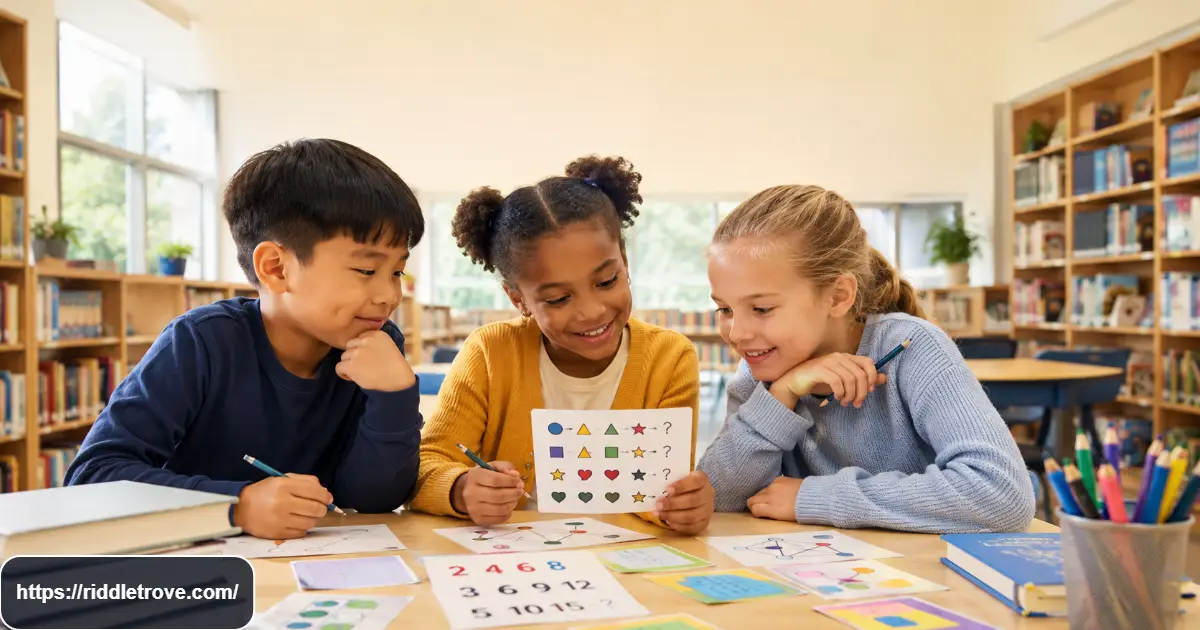
Some brain teasers are solved in seconds. Others make you stop, rethink the clue, and try a completely different approach. This collection mixes both, so kids can build confidence before tackling tougher puzzles.
You’ll find wordplay, logic, math, patterns, funny twists, everyday mysteries, and lateral-thinking challenges. Start anywhere, or work from the easier sections toward the Final Challenge.
For younger kids, give a hint before revealing the answer. For older kids, cover the answers and turn the list into a family or classroom challenge.
Quick & Easy Brain Teasers 🧠
Riddle 1: I have pages but I am not a website. I can take you places without moving. What am I?
Answer: A book.
Riddle 2: I have a face and two hands, but I cannot clap. What am I?
Answer: A clock.
Riddle 3: I am full of holes, but I can still hold water. What am I?
Answer: A sponge.
Riddle 4: I get smaller every time I take a bath. What am I?
Answer: A bar of soap.
Riddle 5: I have four legs, but I never take a walk. What am I?
Answer: A table.
Riddle 6: You can catch me, but you cannot throw me. What am I?
Answer: A cold.
Riddle 7: I have one eye, but I cannot see. What am I?
Answer: A needle.
Riddle 8: I have teeth, but I cannot bite. What am I?
Answer: A comb.
Riddle 9: I go up when rain comes down. What am I?
Answer: An umbrella.
Riddle 10: I follow you everywhere during the day, but disappear in the dark. What am I?
Answer: Your shadow.
Riddle 11: I have a neck but no head. What am I?
Answer: A bottle.
Riddle 12: I can be cracked, made, told, and played. What am I?
Answer: A joke.
Clever Everyday Brain Teasers 🔎
Riddle 13: A farmer has five chickens. Each chicken lays one egg today. How many eggs does the farmer have?
Answer: Five eggs.
Riddle 14: What gets wetter the more it dries?
Answer: A towel.
Riddle 15: I can be opened without a key, but I am not a door. What am I?
Answer: An envelope.
Riddle 16: I have a tongue but cannot taste. I can be tied but cannot walk. What am I?
Answer: A shoe.
Riddle 17: What can travel around the world while staying in one corner?
Answer: A stamp.
Riddle 18: I am always coming, but I never arrive. What am I?
Answer: Tomorrow.
Riddle 19: What has many keys but cannot open a single lock?
Answer: A piano.
Riddle 20: I become shorter whenever I work. What am I?
Answer: A pencil.
Riddle 21: What can you hold without ever touching it?
Answer: Your breath.
Riddle 22: I have a ring but no finger. What am I?
Answer: A telephone.
Riddle 23: What can run but never walks and has a bed but never sleeps?
Answer: A river.
Riddle 24: I have a head and a tail but no body. What am I?
Answer: A coin.
Word & Language Brain Teasers 🔤
Riddle 25: What word becomes shorter when you add two letters to it?
Answer: Short. Add “er” to make “shorter.”
Riddle 26: What five-letter word becomes shorter when you add two letters?
Answer: Short. The wordplay is in the meaning, not the original letter count.
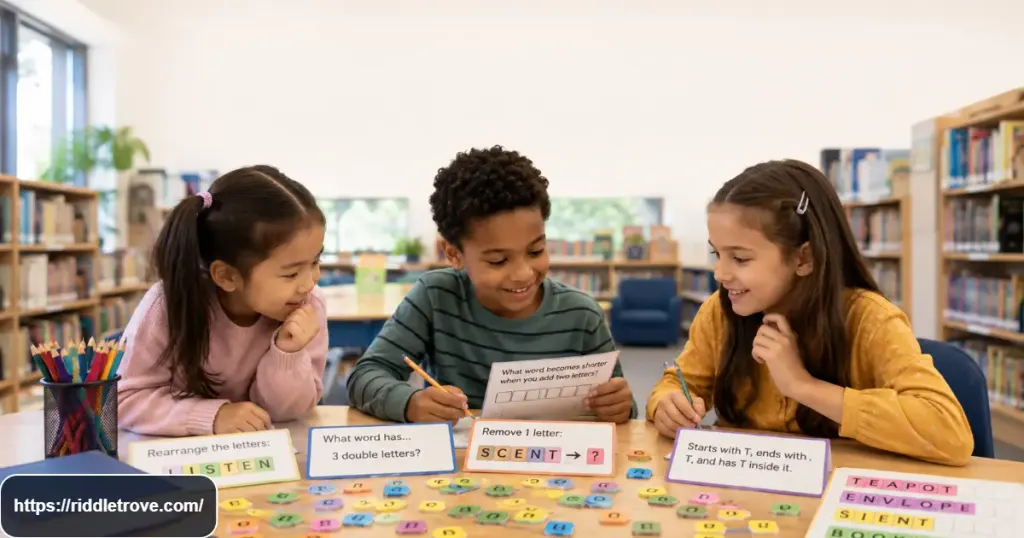
Riddle 27: What begins with T, ends with T, and has T inside it?
Answer: A teapot.
Riddle 28: What word sounds the same when you remove its first letter and when you remove its last letter?
Answer: Scent. Remove the first letter and you get “cent”; remove the last letter and you get “scen.”
Riddle 29: What starts with an E, ends with an E, but contains only one letter?
Answer: An envelope.
Riddle 30: What English word contains three consecutive double letters?
Answer: Bookkeeper.
Riddle 31: What has four letters, sometimes has nine letters, but never has five letters?
Answer: The words “what,” “sometimes,” and “never” themselves. “What” has four, “sometimes” has nine, and “never” has five, so this classic wording does not actually satisfy the last clue. What is the corrected answer?
Answer: There isn’t one under that wording. This is a wording trap, so the riddle is testing whether you notice the inconsistency.
Riddle 32: What word can you spell using the first letters of “red, orange, yellow, green, blue”?
Answer: ROYGB, the initial sequence of those colors.
Riddle 33: If you rearrange the letters in “LISTEN,” what word can you make?
Answer: SILENT.
Riddle 34: What word has the same number of letters as its answer?
Answer: “Four” has four letters.
Riddle 35: What begins with P, ends with E, and has thousands of letters?
Answer: A post office.
Riddle 36: What has words but never speaks?
Answer: A dictionary.
Logic Riddles 🧩
Riddle 37: Maya is taller than Leo. Leo is taller than Sam. Who is shortest?
Answer: Sam.
Riddle 38: Three boxes are labeled Apples, Oranges, and Mixed. Every label is wrong. You may pick one fruit from one box. Which box should you choose first?
Answer: The box labeled Mixed. Since its label is wrong, it must contain only apples or only oranges, letting you identify the other boxes by elimination.
Riddle 39: Two children share three apples equally, and no apple is cut. How can this happen?
Answer: There are three children, not two. The wording says “two children share three apples equally,” which is impossible without cutting, so the trick is to recognize that the conditions cannot all be true.
Riddle 40: A boy has two sisters. Each sister has the same two brothers. How many children are in the family?
Answer: Five children: two sisters and three brothers.
Riddle 41: Four friends sit in a row. Ava is left of Ben. Cara is right of Ben. Dan is at the far right. Who can sit between Ava and Ben?
Answer: No one. Ava and Ben are adjacent because Cara must be right of Ben and Dan is already at the far right.
Riddle 42: A race has three runners. Mia finishes before Noah, and Noah finishes before Zoe. Who finishes last?
Answer: Zoe.
Riddle 43: You have three switches downstairs and one light upstairs. Only one switch controls the light. You may go upstairs once. How can you identify the switch?
Answer: Turn on one switch for a while, then turn it off. Turn on a second switch and go upstairs. If the bulb is lit, it is the second switch. If it is off but warm, it is the first.
Math Brain Teasers ➗
Riddle 44: I am an even number between 10 and 20. My digits add to 9. What number am I?
Answer: 18.
Riddle 45: I am a two-digit number. My tens digit is 3, and my ones digit is twice my tens digit. What am I?
Answer: 36.
Riddle 46: Two numbers add to 20 and differ by 4. What are they?
Answer: 12 and 8.
Riddle 47: Three numbers add to 18. The second is twice the first, and the third is three times the first. What are they?
Answer: 3, 6, and 9.
Riddle 48: I am thinking of a number. Double me and add 6 to get 20. What number am I?
Answer: 7.
Riddle 49: A box contains 4 rows of 5 marbles. How many marbles are inside?
Answer: 20.
Riddle 50: A number is greater than 30 but less than 40. Its digits multiply to 18. What is it?
Answer: 36.
Riddle 51: What number comes next: 2, 4, 8, 16, ___?
Answer: 32.
Riddle 52: What number comes next: 5, 10, 15, 20, ___?
Answer: 25.
Riddle 53: I am a number between 40 and 50. My digits add to 10. What am I?
Answer: 46.
Riddle 54: You have 12 cookies and give one-third of them away. How many remain?
Answer: 8.
Riddle 55: A rectangle has four sides. If you draw one straight line across it from one corner to the opposite corner, how many triangles are formed?
Answer: Two.
Number & Pattern Puzzles 🔢
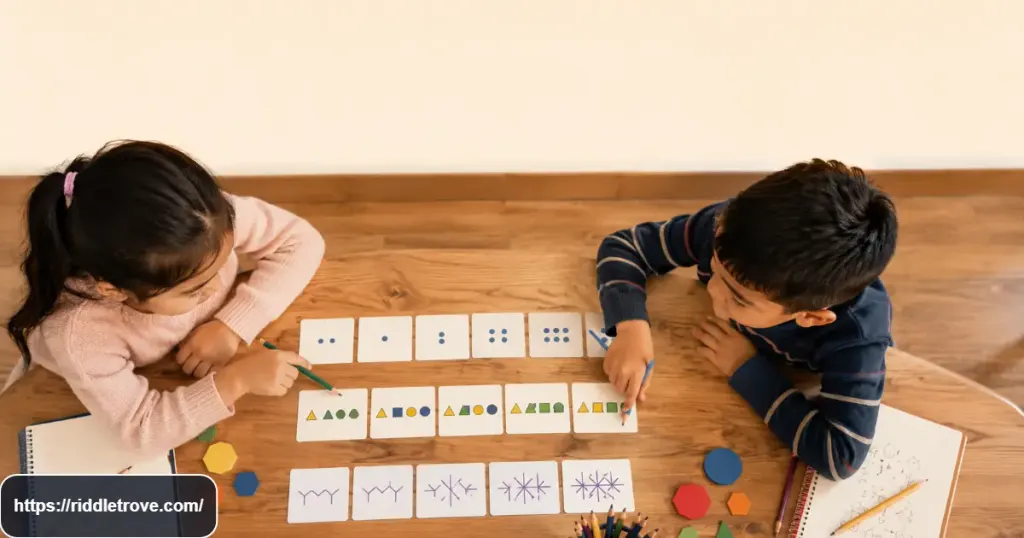
Riddle 56: What comes next: 1, 3, 6, 10, 15, ___?
Answer: 21. Each step adds the next counting number.
Riddle 57: What comes next: 81, 27, 9, 3, ___?
Answer: 1.
Riddle 58: What comes next: 4, 7, 10, 13, ___?
Answer: 16.
Riddle 59: What comes next: 100, 90, 80, 70, ___?
Answer: 60.
Riddle 60: What comes next: 1, 4, 9, 16, ___?
Answer: 25. These are square numbers.
Riddle 61: What comes next: 2, 3, 5, 8, 12, ___?
Answer: 17. The increases are 1, 2, 3, 4, then 5.
Riddle 62: What number is missing: 3, 6, 12, 24, ___, 96?
Answer: 48.
Riddle 63: A sequence begins 20, 18, 15, 11, 6. What comes next?
Answer: 0. The amounts subtracted are 2, 3, 4, 5, then 6.
Riddle 64: Which number does not belong: 12, 18, 24, 31, 36?
Answer: 31. The others are divisible by 6.
Riddle 65: I am a number whose double is 14 more than I am. What number am I?
Answer: 14.
Funny Brain Teasers 😄
Riddle 66 : What kind of tree can you carry in your hand?
Answer: A palm tree.
Riddle 67: Why did the pencil get promoted?
Answer: Because it had a sharp point.
Riddle 68: What has ears but cannot hear?
Answer: Corn.
Riddle 69: What do you call a sleeping bull?
Answer: A bulldozer.
Riddle 70: What has a bottom at the top?
Answer: Your legs.
Riddle 71: Why did the math book look sad?
Answer: It had too many problems.
Riddle 72: What kind of coat is always wet when you put it on?
Answer: A coat of paint.
Riddle 73: What has a head, a tail, is brown, and has no legs?
Answer: A penny.
Riddle 74: Why can’t your nose be 12 inches long?
Answer: Because then it would be a foot.
Riddle 75: What do you call a bear with no teeth?
Answer: A gummy bear.
Tricky Lateral-Thinking Riddles 🕵️
Riddle76: A man walks into a room and sees three doors. One says FIRE, one says LIONS, and one says WATER. Which sign tells him the least about what is behind the door?
Answer: None by itself. A sign does not guarantee that the stated danger is actually present.
Riddle 77: A girl drops a glass on a carpet, but the glass does not break. Why?
Answer: It was an empty plastic glass.
Riddle 78: A driver travels the wrong way down a one-way street but does not break the law. How?
Answer: The driver is walking.
Riddle 79: A child is born on February 29. In a year without February 29, when can the child celebrate the birthday date?
Answer: February 28 or March 1, depending on the family or local convention. The calendar date itself does not occur that year.
Riddle 80: You enter a dark room with one match. There is a candle, a lamp, and a fireplace. What do you light first?
Answer: The match.
Riddle 81: A farmer has 17 sheep. All but 9 run away. How many remain?
Answer: 9.
Riddle 82: A plane crashes exactly on the border between two countries. Where should the survivors be buried?
Answer: Nowhere. Survivors are not buried.
Riddle 83: A child has a pet that can jump higher than a house. How is this possible?
Answer: A house cannot jump.
Riddle 84: A man shaves several times every day but still has a beard. Who is he?
Answer: A barber.
Riddle 85: A person looks at a photograph and says, “Brothers and sisters, I have none, but that person’s father is my father’s son.” Who is in the photograph?
Answer: His son.
What Am I? Brain Teasers 🎯
Riddle 86: I am soft, I fall from the sky, and children sometimes use me to make a snowball. What am I?
Answer: Snow.
Riddle 87: I have wings, but I am not a bird. I can fly, but I am not alive. What am I?
Answer: An airplane.
Riddle 88: I glow at night, but I am not a lamp. I change shape throughout the month. What am I?
Answer: The Moon.
Riddle 89: I have a spine but no bones. What am I?
Answer: A notebook.
Riddle 90: I can be folded, mailed, and opened, but I am not a book. What am I?
Answer: A letter.
Riddle 91: I have strings but no shoes. You can pluck me to make music. What am I?
Answer: A guitar.
Riddle 92: I have a face, numbers, and hands, but I never wave. What am I?
Answer: A watch.
Riddle 93: I am made of wood, have bristles, and help paint a wall. What am I?
Answer: A paintbrush.
Riddle 94: I can be locked, unlocked, opened, and closed, but I am not a door. What am I?
Answer: A computer account.
Riddle 94: I am small, round, and colorful. I can bounce and roll, and children play with me. What am I?
Answer: A ball.
Family & School Brain Teasers 👨👩👧👦
Riddle 95: A teacher has 24 pencils and puts them equally into 6 cups. How many pencils go in each cup?
Answer: 4.
Riddle 96: Four students each bring two books. How many books are there altogether?
Answer: 8.
Riddle 97: A classroom has 6 rows with 4 desks in each row. How many desks are there?
Answer: 24.
Riddle 106: Emma is older than Liam but younger than Noah. Who is in the middle?
Answer: Emma.
Riddle 98: Three siblings share 12 stickers equally. How many stickers does each receive?
Answer: 4.
Riddle 99: A school bus has 8 students. Three get off, then two get on. How many students are on the bus?
Answer: 7.
Riddle 100: A teacher writes Monday, Tuesday, Wednesday, Thursday, Friday on the board. Which day comes after Friday?
Answer: Saturday.
Riddle 101: A family has two parents and three children. Each child has one backpack. How many backpacks do the children have?
Answer: 3.
Hard Brain Teasers for Older Kids 🔥
Riddle 102: You have 8 identical-looking coins, but one is lighter. Using a balance scale only twice, can you always find the lighter coin?
Answer: Yes. Weigh 3 against 3. If they balance, the lighter coin is among the remaining 2, which can be compared once. If they do not balance, take the lighter group of 3 and weigh 1 against 1 to identify the lighter one or conclude the third is lighter.
Riddle 103: A farmer needs to cross a river with a fox, a chicken, and a bag of grain. The boat holds the farmer plus one item. How can everything cross safely?
Answer: Take the chicken across, return alone, take the fox across, bring the chicken back, take the grain across, return alone, then take the chicken across again.
Riddle 104: You have three boxes. One contains only red balls, one only blue balls, and one contains both. Every label is wrong. You may remove one ball from one box. Which labeled box should you choose?
Answer: The box labeled “Red and Blue.” Because its label is wrong, it must contain only one color. The ball you draw identifies that box, and the remaining labels can then be corrected by elimination.
Riddle 105: A sequence follows this rule: 2, 6, 12, 20, 30, ___. What is next?
Answer: 42. The differences are 4, 6, 8, 10, then 12.
Riddle 106: A clock shows 3:00. What is the angle between the hour hand and minute hand?
Answer: 90 degrees.
Final Brain Teaser Challenge 🏆
Riddle 107: You have 12 identical-looking balls. One is different in weight, but you do not know whether it is heavier or lighter. With a balance scale, what makes this puzzle much harder than simply finding a heavier ball?
Answer: You must determine both which ball is different and whether it is heavier or lighter. The uncertainty doubles because the unusual ball can differ in either direction.
Riddle 108: Three friends, Ava, Ben, and Cara, each choose a different snack: an apple, a sandwich, or yogurt. Ava does not choose yogurt. Ben does not choose the apple. Cara chooses neither the sandwich nor the yogurt. What does each friend choose?
Answer: Cara chooses the apple. Ben must choose yogurt, leaving the sandwich for Ava.
Riddle 109: A number has two digits. The tens digit is 4 more than the ones digit. The digits add to 10. What number is it?
Answer: 73.
Riddle 110: Five boxes are arranged in a row. The red box is somewhere left of the blue box. The green box is immediately right of the yellow box. The blue box is immediately right of the green box. Which color must be immediately left of the blue box?
Answer: Green.
Riddle 111: You have three identical bags. One contains only red marbles, one contains only blue marbles, and one contains both colors. All three labels are wrong. You may take one marble from one bag without looking inside. What is the minimum information you need from that single draw to correctly relabel every bag?
Answer: The color of the marble drawn. Choose the bag labeled “Red and Blue.” Since that label is wrong, the bag must contain only one color. Once its true color is known, the other two bags can be identified by elimination.
How to Use These Brain Teasers With Kids
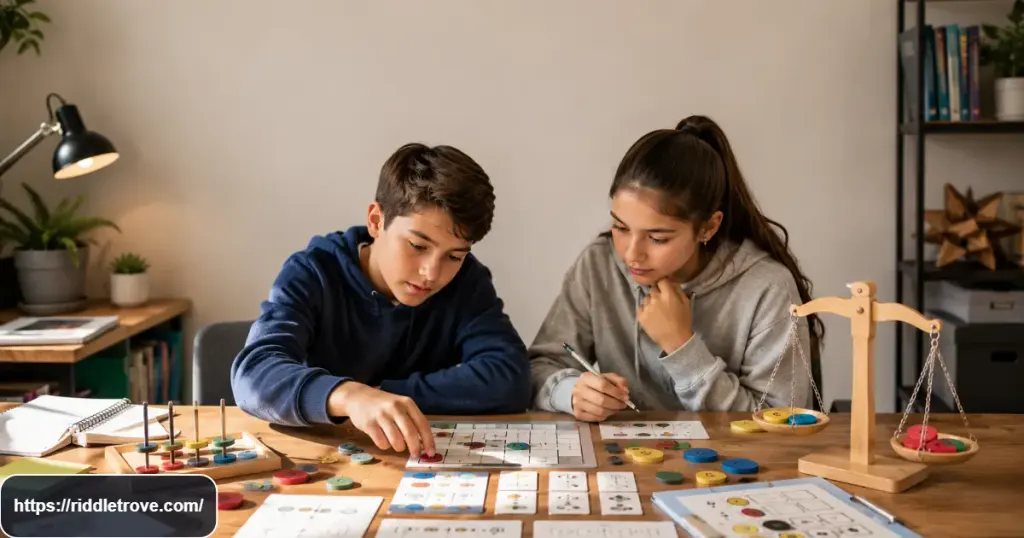
Let kids try each puzzle before showing the answer. For an easier game, offer one small hint after 30 seconds. For harder puzzles, ask the child to explain why the answer works rather than simply naming it.
At home, mix easy and tricky questions so younger children can participate while older kids still have something to solve.
Conclusion
These brain teasers for kids with answers are designed to give children more than a list of quick questions. The collection moves from simple observation and wordplay into math, logic, patterns, lateral thinking, and multi-step challenges.
Start with the easier riddles, then work toward the harder sections without rushing to reveal the answers. The best puzzle is often the one that makes a child pause, test an idea, and proudly explain how they figured it out.
Frequently Asked Questions
What age are these brain teasers for?
Most are suitable for children around ages 6–13, although difficulty varies. Younger children may need hints, while older kids can tackle the logic and Final Challenge sections independently.
Are brain teasers good for kids?
Yes. Well-designed brain teasers can encourage reasoning, pattern recognition, problem solving, careful reading, and creative thinking.
Should I show the answer right away?
It is usually more fun to give children time to solve the puzzle first. A hint can be more useful than immediately revealing the answer.
Are math brain teasers the same as regular math questions?
Not always. A strong math brain teaser adds a puzzle element such as a pattern, hidden relationship, comparison, or reasoning step rather than simply asking for a calculation.
What are good brain teasers for younger kids?
Start with familiar objects, simple observations, basic patterns, and short wordplay. The Quick & Easy section is a good starting point.
How can I make these riddles harder?
Hide the answers, remove hints, set a time limit, or ask the child to explain every reasoning step. You can also move from the easy sections toward the Tricky and Final Challenge sections.
Can teachers use these brain teasers in class?
Yes. Short riddles work well as warm-ups, brain breaks, early-finisher activities, and discussion starters. Choose puzzles that fit the students’ reading and reasoning levels.
What is the difference between a riddle and a brain teaser?
A riddle often uses clues or wordplay to identify an answer. A brain teaser is broader and can include logic problems, patterns, lateral-thinking puzzles, math reasoning, and clever trick questions.
How do I keep kids interested in a long riddle collection?
Vary the puzzle type and difficulty. Let children choose between wordplay, math, logic, funny riddles, and harder challenges instead of requiring them to solve every puzzle in order.